
From Novel to Transmedia IP: Robojit’s AI-Assisted Production Pipeline
Instead of waiting for studio financing or closed-door greenlights, Robojit artifacts are released publicly across platforms — websites, articles, visual previews, and international editions.
RMN Stars Technology Desk
New Delhi | January 26, 2026
The global film and entertainment industry continues to rely on production models that are expensive, fragmented, and resistant to structural change. Despite advances in digital tools, most storytelling projects still move from script to screen through ad-hoc processes that concentrate risk late in the pipeline and inflate costs before market validation.
Robojit and the Sand Planet is being developed as a live experiment in an alternative approach: an AI-assisted, manufacturing-style production pipeline that treats storytelling as a system — not a one-off artistic gamble.
The objective is not to automate creativity or replace human authorship, but to re-engineer how stories are developed, prototyped, tested, and scaled in a rapidly changing media landscape.
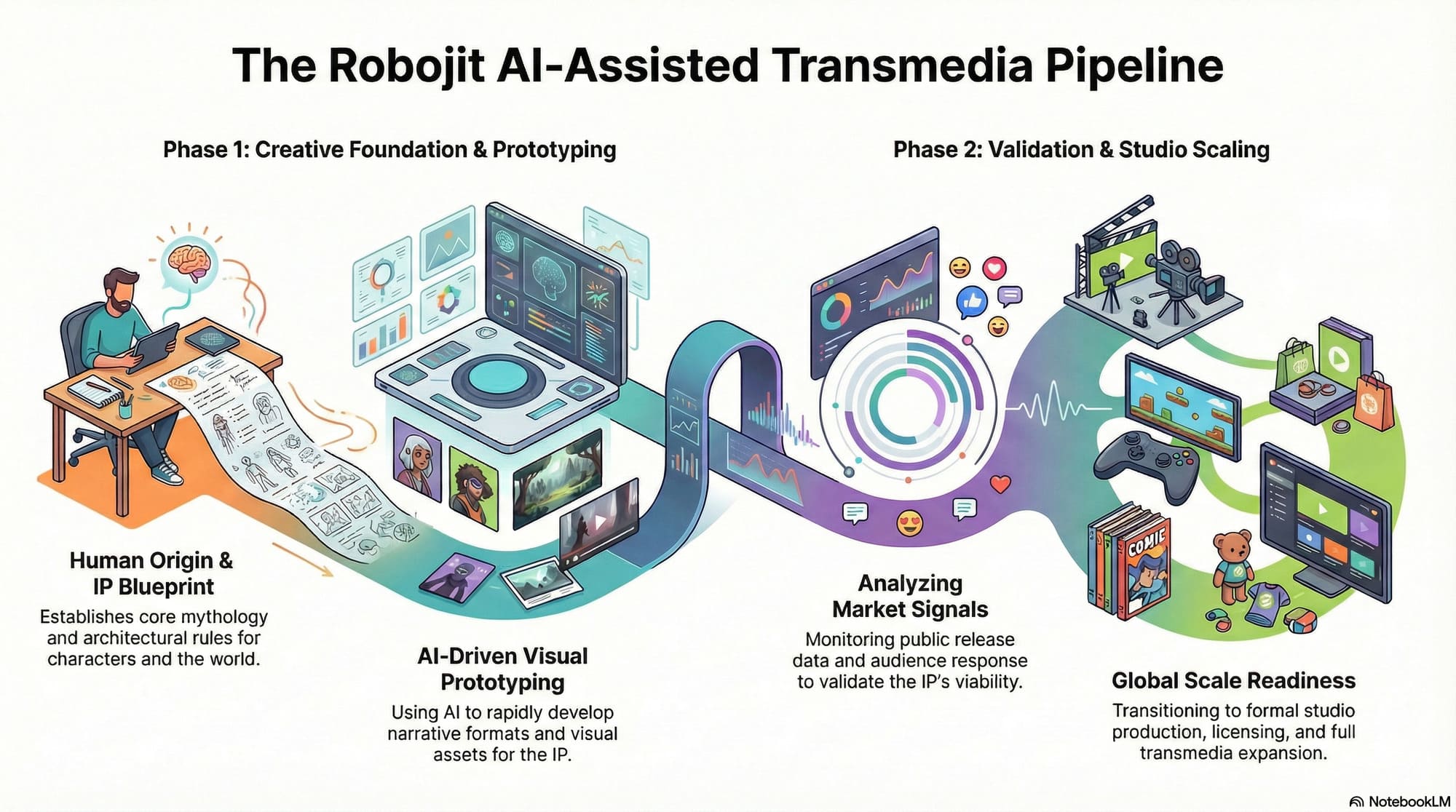
The diagram above outlines the end-to-end pipeline currently in use.
1. Human Origin: Story as the Immutable Core
At the foundation of the pipeline is a fully human-written novel.
Robojit and the Sand Planet was authored more than a decade ago, long before generative AI tools existed. Its story, characters, themes, and mythology form a fixed creative core that is not altered by automation.
This stage establishes a critical principle: AI is applied downstream, not at the point of authorship. Creative intent originates with the human creator and remains the reference point for all subsequent production decisions.
2. IP Blueprint: Structuring the Story World
In the second stage, the narrative universe is formalized into an IP blueprint. This includes defining character architectures, world rules, thematic boundaries, and narrative continuity in a way that allows the story to travel across formats.
By treating the story world as structured intellectual property rather than a single-format work, the project becomes adaptable to film, animation, graphic novels, interactive media, and global localization — without losing coherence.
3. AI Prototyping: Accelerated Visualization and Format Testing
AI tools are introduced at the prototyping stage, where they offer the greatest efficiency gains with the least creative risk.
Here, AI is used to:
-
Generate visual concepts and scene interpretations
-
Convert narrative material into screenplay excerpts
-
Create graphic novel prototypes and explainer visuals
-
Experiment with multiple narrative formats quickly and affordably
This stage replaces traditional high-cost pre-production with rapid, low-risk experimentation, allowing ideas to be tested before significant capital is committed.
4. Market Signals: Publishing Before Scaling
Instead of waiting for studio financing or closed-door greenlights, Robojit artifacts are released publicly across platforms — websites, articles, visual previews, and international editions.
These releases function as market signals:
-
Audience interest
-
Platform response
-
Geographic reach
-
Format resonance
Feedback is observed in real time, allowing the project to evolve based on evidence rather than speculation.
5. Scale Readiness: Preparing for Studio and Licensing Models
Only after narrative validation and audience traction does the pipeline move toward scale.
At this stage, the project is prepared for:
-
Studio partnerships
-
Co-production models
-
Licensing and international expansion
-
Long-form film, series, or animation development
Because the groundwork has already been laid — creatively, visually, and structurally — scale becomes a controlled expansion rather than a leap of faith.
A Manufacturing Mindset for Storytelling
This pipeline applies a manufacturing mindset to creative production: clear inputs, staged processing, early testing, and scalable outputs. Each new Robojit artifact functions simultaneously as a creative release and a validation of the system itself.
The intention is not to position Robojit as an exception, but as proof of concept — demonstrating how AI-assisted workflows can reduce cost, shorten timelines, and preserve creative integrity in an industry overdue for structural innovation.
As the project continues, every new release will represent a measurable output of this pipeline, contributing to a broader conversation about how stories can be built — not just told — in the AI era.
Robojit Website | IMDb | FilmFreeway | ISA | YouTube | Twitter (X) | Facebook