
Dhurandhar The Revenge: How Bollywood’s New ‘Muscular’ Action Genre Masks a Democratic Decay
The current creative ecosystem in Bollywood is characterized by an increasing dependence on Pakistan-centric storylines, mirroring a political climate where rhetorical adversaries are invoked to rally domestic support.
By Rakesh Raman
New Delhi | March 7, 2026
For decades, the Hindi film industry functioned as India’s premier export of “soft power,” a cultural ambassador that broadcasted a vibrant, pluralistic identity to the world. We were a nation of melodic romances and complex family epics that celebrated a syncretic social fabric. However, a systemic alignment of popular culture with state ideology has fundamentally altered the landscape. The silver screen, once a site of diverse emotional resonance, has been re-engineered into a theater of exploding cars, high-stakes espionage, and a specific brand of muscular rhetoric.
This transformation is far more profound than a mere shift in genre preference; it is a calculated ideological pivot. Modern Bollywood is no longer content with mere entertainment. Instead, it has increasingly become a vehicle for a “muscular manifesto,” where the cinematic apparatus is used to project a “Naya Hindustan” (New India). As a media sociologist, one must look past the pyrotechnics to see the “big picture”: a industry-wide migration toward narratives that reinforce a specific, exclusionary nationalist identity.
The Rise of “Naya Hindustan”: Cinema as a Muscular Manifesto
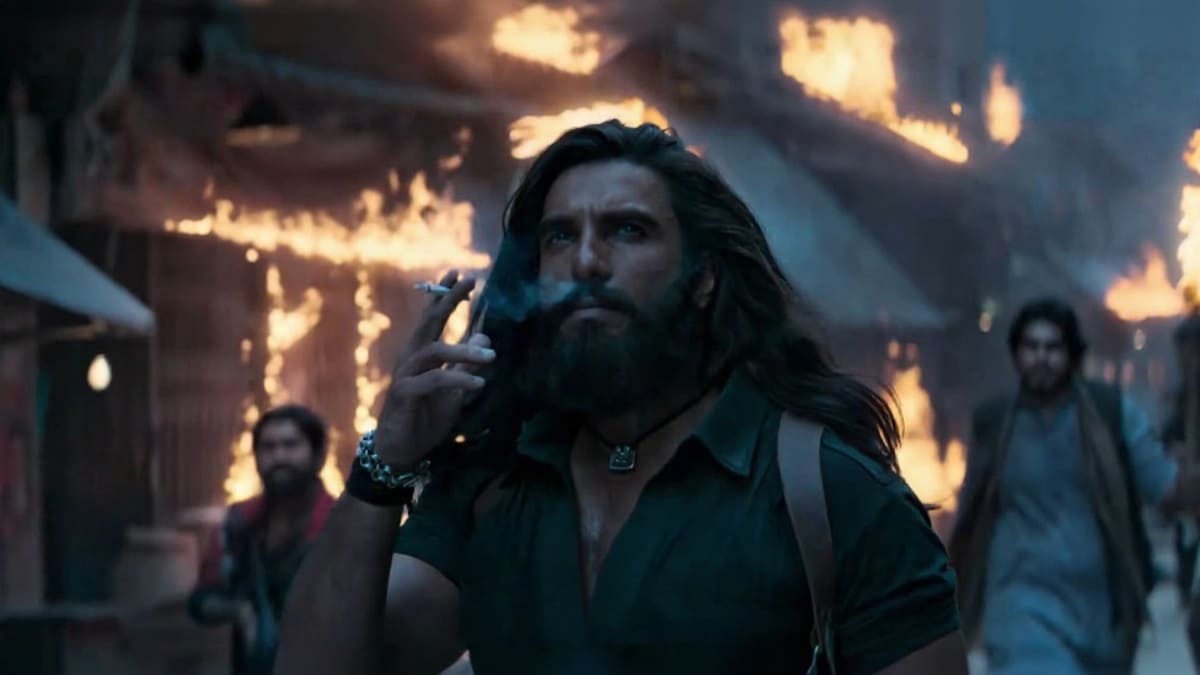
The most potent symbol of this shift is the Dhurandhar franchise. These films do not simply depict conflict; they establish a new moral universe where the Indian state is a punitive, unstoppable force. In the upcoming Dhurandhar: The Revenge (2026), the character of Jaskirat Singh Rangi—who infiltrates the Pakistani underworld as “Hamza,” the so-called “Badshah of Lyari”—serves as a archetype for this new era. His dual identity and psychological trauma are framed not as tragedy, but as the necessary molding of a weapon for the Intelligence Bureau.
[ The Global Cinema Resurgence: Theatrical Movie Market Research Report ]
This “muscular manifesto” is encapsulated in a single, chilling cinematic dog-whistle found in the film’s teaser:
“Yeh Naya Hindustan hai. Yeh ghar mein ghusega bhi. Aur maarega bhi.”
🔊 बॉलीवुड फिल्मों में दुश्मनी भरा राष्ट्रवाद और नफ़रत: ऑडियो विश्लेषण
The phrase “Naya Hindustan” has been stripped of its neutrality, functioning now as a moral divider between the idealized, assertive nation and its perceived external and internal enemies. It is a form of communalized externalization—coded hostility that requires no explicit naming of “the other” because the subtext is already baked into the cultural consciousness.
The Smokescreen Effect: Why Spectacle Replaces Scrutiny
To understand why this shift is occurring, we must look to the “Smokescreen 2026” report, a critical framework that examines how manufactured nationalism is used to sustain the illusion of democratic legitimacy. In a period marked by “institutional capture” and “electoral opacity,” hyper-nationalist cinema performs a vital service for the status quo. It functions as a distraction, using loud symbols of external strength to obscure quieter, more pressing questions regarding democratic integrity and accountability.
This redirection of emotion is far more effective than a standard action sequence because it achieves “manufactured consent.” By converting political unease into shared cinematic catharsis, these films ensure that the public’s frustration is aimed at a fictionalized external foil rather than the very real institutional failures at home. When spectacle replaces scrutiny, the audience is no longer a group of citizens, but a collective of spectators participating in their own narrative reinforcement.
Pakistan as the Perpetual Narrative Foil
The current creative ecosystem in Bollywood is characterized by an increasing dependence on Pakistan-centric storylines, mirroring a political climate where rhetorical adversaries are invoked to rally domestic support. This trend is evident in a growing list of “safe bets”:
- Lahore 1947
- Dhurandhar and Dhurandhar: The Revenge
- Ikkis
- Border 2
- Battle of Galwan
Even Lahore 1947, which follows a Muslim family migrating from Lucknow to Lahore during the Partition, is being positioned within this “ideologically safe” framework. By sanitizing one of the subcontinent’s most traumatic episodes into a nationalist narrative, the industry avoids the messy complexities of pluralism. This reliance on a perpetual foil reveals a creative bankruptcy; the industry is no longer interested in exploring the human condition, but in repeating communalized templates that guarantee domestic returns.
The High Price of “Safe Bets”: Soft Power vs. The Box Office
The domestic financial success of these films is staggering—the first Dhurandhar (2025) reportedly hauled in ₹1,300 crore*. However, this focus on exclusionary nationalism is actively dismantling decades of cultural diplomacy. While these films rally applause at home, they are meeting a wall of resistance internationally, particularly in markets that previously embraced Bollywood’s pluralistic charm.
* RMN Stars News Service cannot independently verify the Dhurandhar box office figures.
The global backlash is not merely a matter of censorship; it is a rejection of films that trade in communal signaling. Specific titles, including Border 2 and Dhurandhar, have faced official bans in several countries:
- Bahrain
- Kuwait
- Oman
- Qatar
- Saudi Arabia
- The United Arab Emirates (UAE)
For the sake of short-term domestic gains, Bollywood is sacrificing its global diaspora reach. The “easy money” of the current nationalist wave is eroding India’s international cultural appeal, narrowing the nation’s soft power to a point of near-irrelevance on the world stage.
The Calendar as a Tactical Weapon
The strategic timing of these releases further highlights their role as ideological tools. Aamir Khan Productions has scheduled Lahore 1947 for August 13, directly exploiting the emotional high of Independence Day week. Similarly, Dhurandhar: The Revenge is slated for March 19, 2026—a date that meticulously straddles Gudi Padwa/Ugadi and the lead-up to Eid.
There is a profound irony in releasing a film filled with communal signaling and “muscular” rhetoric specifically timed to coincide with Eid. This tactical use of the calendar ensures that themes of vengeance and national pride are consumed when the public’s emotional investment is at its peak, effectively weaponizing the festive season for narrative reinforcement.
The Danger of the Unquestioned Narrative
The trajectory of “New Bollywood” suggests a future where cinema is indistinguishable from state manifesto. When films repeatedly frame aggression as the only valid form of patriotism and define the “enemy” in racialized terms, they do more than entertain—they indoctrinate. They teach the audience that the only way to love the country is to fear the outsider and trust the authority implicitly.
The core danger of the smokescreen is that when movies constantly teach us who the enemy is, they also subtly teach us whom we should not question. We are being trained to ignore “institutional capture” in favor of watching Hamza eliminate a fictional terror architect.
As you sit in the theater, surrounded by the roar of cinematic catharsis, you must ask yourself a difficult question: Are you merely a spectator of this “Naya Hindustan,” or have you become an accomplice in the disappearance of the India that once was?
By Rakesh Raman, who is a national award-winning journalist and founder of the humanitarian organization RMN Foundation. As an emerging international screenwriter, his work is gaining visibility on leading entertainment industry platforms, including IMDb and the International Screenwriters’ Association (ISA).
He is building AI-assisted, manufacturing-style production pipelines for his global film and entertainment projects including the humanoid superhero transmedia IP ROBOJIT AND THE SAND PLANET and the research-based political thriller THE SMOKESCREEN which is envisioned as the first installment in a broader cinematic universe.