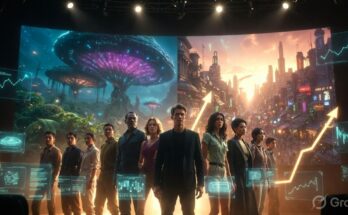

How AI is Redefining Filmmaking: From Production Pipelines to Creative Collaboration
The integration of Artificial Intelligence into the entertainment industry is not a monolithic takeover but a multifaceted evolution with profound implications.
By Rakesh Raman
New Delhi | January 17, 2026
Artificial Intelligence is no longer a futuristic concept whispered about in the corridors of Hollywood; it is a tangible force actively reshaping the global entertainment industry. This technological evolution is moving beyond mere special effects to fundamentally alter how films are financed, created, and even conceived.
This analysis explores the multifaceted impact of AI on filmmaking, examining its disruption of traditional production models, its emergence as a powerful collaborative tool for creators, and its potential to foster a new wave of positive social change through cinema.
1. The AI-First Pipeline: Disrupting the Hollywood Investment Model
Artificial Intelligence is fundamentally altering the high-risk, high-cost nature of modern film production. The traditional model, which often requires massive upfront investment based on scripts and concepts alone, is being challenged by a more calculated, technology-driven approach. The “AI-first” pipeline represents a strategic shift that de-risks major investments by enabling creators to front-load the development of core creative assets, presenting investors with a tangible, high-fidelity vision from the outset.
A prime example of this new model is the global entertainment project “Robojit and the Sand Planet.” By employing a proprietary AI-first pipeline, the creative team has achieved several key milestones before seeking major investment, radically changing the value proposition for potential backers:
- Finalized High-Fidelity Environments: By completing the creation of detailed and visually rich settings, the project replaces abstract pitch decks with a tangible, interactive universe, drastically reducing the imaginative leap required from potential investors.
- Completed Character Models: With core character designs fully realized as production-ready assets, the project mitigates the financial risk associated with a lengthy and uncertain character development phase.
- Developed Narrative Assets: Key story elements have been established and visualized through the AI-powered workflow, offering investors concrete proof of the concept’s narrative viability and visual appeal.
This AI-driven approach to IP development presents a direct and potent challenge to the established industry’s risk-averse, franchise-dependent playbook. The project explicitly “aims to disrupt Hollywood’s superhero formula” by demonstrating that compelling, large-scale entertainment can be developed more efficiently and with greater financial foresight.
🔊 How AI is Redefining Filmmaking: Audio Analysis
By completing a significant portion of the creative heavy lifting upfront, this model reduces investor uncertainty and shifts the power dynamic, allowing new IP to compete with established franchises on more solid ground. This disruption in the production pipeline is made possible by an emerging generation of sophisticated AI tools designed to work in concert with human creativity.
2. A New Cinematic Sandbox: Google’s Vision for Human-AI Collaboration
Amid industry-wide debates over the role of AI, Google is championing a collaborative approach that focuses on augmenting human creativity rather than replacing it. This strategy positions AI as a powerful partner for filmmakers, providing them with what is described as a “dynamic new cinematic sandbox” to explore and refine their vision.
Tools like Veo and Gemini, which allow for rapid video creation from natural language, are precisely the kind of technology that could enable a pipeline like that of “Robojit and the Sand Planet,” dramatically accelerating the pre-production and visualization process. Google is developing a suite of tools designed to integrate seamlessly into the filmmaking process, from initial concept to final visualization.
| Google’s AI Tool/Concept | Stated Capability |
| Cinematic with ‘Flow’ | Enables the creation, editing, and management of high-quality video clips. |
| Veo & Gemini | A pair of AI models that allow users to create and customize video content through natural language. |
| Visualizing Content with ‘Flow’ | Produces high-quality storyboards and pre-visualization. |
While these tools offer powerful capabilities, Google’s model explicitly affirms that they are not designed to automate the director’s job. The human director remains essential for weaving together the complex narrative and character arcs that define great cinema and for providing the unified artistic vision that gives a film its unique style and emotional resonance. Reinforcing this human-centric model, Google’s strategy is one of direct partnership.
The company is “actively partnering with Hollywood” to ensure its AI tools are integrated thoughtfully into existing production workflows, supporting rather than supplanting the creative professionals who use them. This vision of AI as a collaborative partner extends beyond commercial entertainment, with new platforms emerging to apply these technologies toward purpose-driven storytelling.
3. AI for Social Impact: Fostering a New Generation of Purpose-Driven Film
The application of advanced technology is increasingly being viewed through a lens of social responsibility, extending its purpose beyond commercial gain. The “AI for Good Film Festival” is a prime example of this movement within the entertainment industry, providing a platform that leverages the power of AI to empower creators to address pressing global issues.
The festival has opened a competition seeking original works from filmmakers around the globe, with the core criterion being that these films must specifically leverage Artificial Intelligence in their creation process to drive positive social change. This initiative signals a crucial maturation in the industry’s relationship with AI, moving beyond questions of efficiency to explore the technology’s potential for cultural and social resonance.
It encourages a new generation of storytellers to harness cutting-edge tools not just for aesthetic innovation, but for meaningful impact. This purpose-driven application of AI highlights its expanding and multifaceted role, signaling a future where technology and human storytelling combine to entertain, innovate, and inspire.
Conclusion
The integration of Artificial Intelligence into the entertainment industry is not a monolithic takeover but a multifaceted evolution with profound implications. As we have seen, AI is enabling new production and investment models that de-risk creation and challenge established formulas, exemplified by projects like “Robojit and the Sand Planet.”
Simultaneously, tech leaders like Google are fostering collaborative human-AI partnerships, providing creators with a “cinematic sandbox” that enhances rather than replaces human vision. Finally, initiatives such as the AI for Good Film Festival demonstrate a growing commitment to harnessing this powerful technology for purpose-driven storytelling. This evolving relationship between AI and the filmmaker promises to redefine not only how stories are told, but why.
By Rakesh Raman, who is a national award-winning journalist and editor of this news site RMN Stars. He is also the founder of the humanitarian organization RMN Foundation which is working in diverse areas to help the disadvantaged and distressed people in the society. He is presently engaged in the development of Artificial Narrow Intelligence (ANI) applications and the exploration of Artificial General Intelligence (AGI) frameworks.