
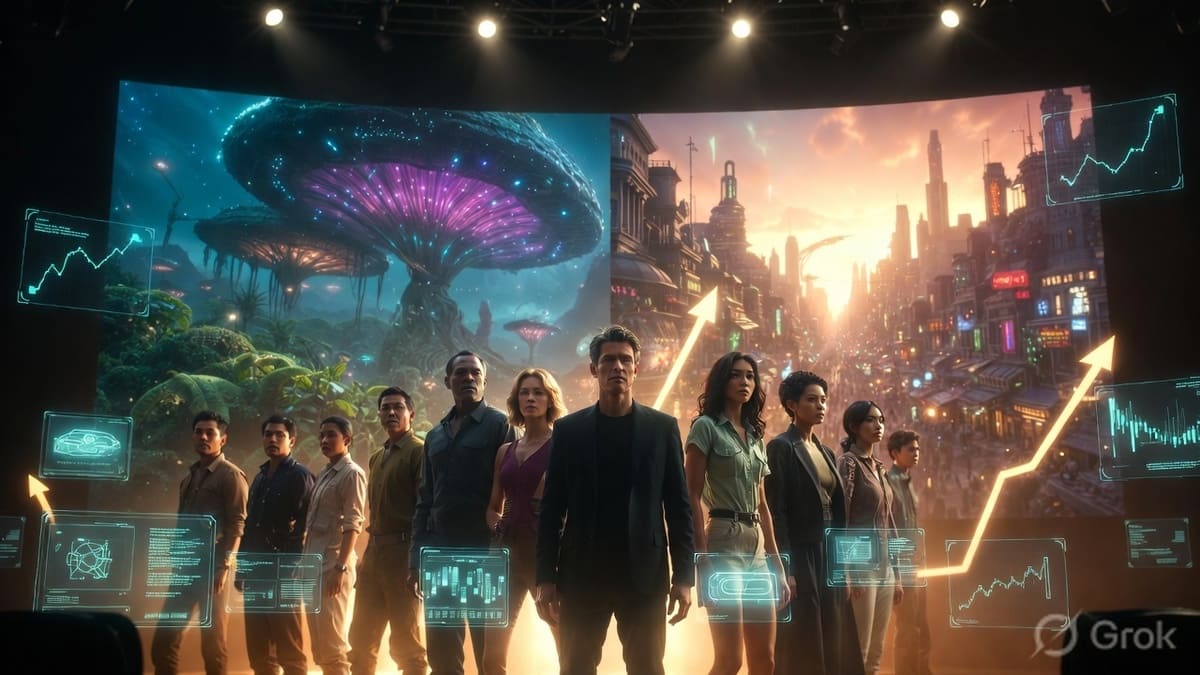
The Global Cinema Resurgence: Theatrical Movie Market Research Report
RMN Stars Research Report Highlights:
This research report by the entertainment news site RMN Stars explores the robust recovery of the global theatrical movie market, which is projected to grow from its 2025 valuation of approximately USD 68–81 billion to over USD 100 billion by 2031–2034.
The report delves into the factors driving this resurgence, such as the success of record-breaking blockbusters like Zootopia 2 and Avatar: Fire and Ash, while also examining the anticipated impact of artificial intelligence (AI) on the market over the next couple of years.
By Rakesh Raman
New Delhi | March 3, 2026
1. State of the Global Theatrical Market (2025–2026)
The global theatrical market is currently undergoing a structural re-engineering, pivoting from a post-pandemic recovery phase into a period of aggressive, high-margin expansion. In 2022, global box office revenue stood at approximately USD 26 billion—a 27% year-over-year increase that nonetheless trailed historical benchmarks.
Today, the trajectory toward multibillion-dollar valuations signals a fundamental evolution in the media landscape: the industry is transitioning from a commodity-based distribution model to an experiential, destination-based model.
Current valuations for the dedicated theatrical exhibition sector in 2025 range between USD 68.37 billion and USD 81.33 billion. While this segment is a subset of the broader $154.7 billion “movies and entertainment” market, its strategic importance cannot be overstated. Theatrical exhibition acts as the “prestige engine” and the critical “top-of-the-funnel” driver for the entire ecosystem.
By establishing brand equity and cultural urgency in theaters, studios catalyze the value of all downstream windows, including streaming and licensing. With a projected Compound Annual Growth Rate (CAGR) of 5.1%, the theatrical niche remains the indispensable halo for global IP.
Market Growth Projections (2025–2034)
| Period | Estimated Market Valuation (USD) | Strategic Focus |
| 2025 – 2026 | $68.37 Billion – $81.33 Billion | Monetization Pivot: Prioritizing ARPPU (Average Revenue Per Paying User) through premium formats. |
| 2031 – 2034 | $108 Billion – $109 Billion | Market Maturation: Integration of AI-driven operational efficiencies and global footprint optimization. |
This financial ascendancy is being localized within specific regional corridors, where shifting consumer demographics are rewriting the geography of cinema revenue.
2. Regional Dominance and Market Share Analysis
The theatrical resurgence is defined by a strategic concentration of market power within North America and Asia. As the primary pillars of global revenue, these regions represent a binary growth engine: North America provides the high-margin stability of a mature market, while Asia offers the scale and volume necessary for long-term expansion.
🔊 Theatrical Movie Market Research Report: Audio Analysis
North America maintains its status as the global revenue leader, commanding a 33.12% market share as of 2025. However, the strategic nature of this dominance is evolving. While the U.S. leads in total revenue, it has reached a point of theatrical saturation. Consequently, growth in this territory is now driven by “technological densification”—extracting higher value from existing footprints. Conversely, China and India represent the industry’s primary volume drivers.
There is a distinct economic contrast here: North America excels in high revenue density and high ARPPU, whereas India and China leverage massive audience engagement and a rapidly expanding physical infrastructure to move the needle on global ticket volume.
- North America: The global anchor with a 33.12% share; focus is on maximizing yield per screen through premiumization.
- China: The world’s second-largest market and a critical gatekeeper for blockbuster scaling and global cume milestones.
- India: A high-growth territory characterized by massive volume and an accelerating transition toward modern, multiplexed exhibition.
Because North America has hit a saturation point in screen count, global growth must now be extracted through technological innovation rather than simple footprint expansion.
3. The Premium Large Format (PLF) Revolution
A pivotal shift in the exhibition landscape is the aggressive move away from volume-based attendance toward high-value, experience-based revenue. Theater owners are no longer merely selling access to content; they are operationalizing the “event” of cinema. This pivot toward premium exhibition allows the industry to increase revenue per patron, effectively decoupling revenue growth from pure attendance figures.
The proliferation of Premium Large Format (PLF) screens—specifically IMAX and Dolby—alongside the universal adoption of laser projection, has created a formidable competitive moat against home entertainment. These technologies offer a sensory fidelity that is impossible to replicate in domestic environments.
Furthermore, by integrating sophisticated food and beverage (F&B) programs, exhibitors have transformed traditional cinemas into luxury hospitality destinations. This integration of high-end amenities serves to diversify revenue streams and insulate margins against fluctuations in film slate performance.
High-Impact Resurgence Factors:
- Technological Superiority: The deployment of IMAX, Dolby, and laser projection establishes a “must-see” mandate for major studio releases.
- Hospitality Integration: Elevating F&B offerings from a secondary concession to a primary luxury experience, significantly boosting per-patron spend.
- Yield Optimization: Leveraging high-ticket pricing for PLF formats to drive revenue growth even in a stabilized attendance environment.
These high-end viewing environments have become the essential delivery mechanism for the only type of content currently capable of generating record-breaking returns: the global blockbuster.
4. The Blockbuster Economy: Sequels and Global Records
The “eventization” of cinema has bifurcated the market, leaving massive sequels as the primary engines of global box office performance. In this “spectacle-first” economy, films are increasingly leveraged as global cultural events, designed to maximize “cume” totals through established IP and premium distribution networks.
Hollywood continues to maintain a dominant competitive moat in this space. This success is not accidental; it is the result of a synergy between high-budget VFX, global IP recognition, and an early monopolization of the PLF distribution network.
Regional competitors often struggle to breach this barrier to entry, as Hollywood’s mastery of the “spectacle” format aligns perfectly with the current global demand for premium theatrical experiences.
- Zootopia 2: Approaching the $2 billion global milestone, leveraging multi-generational IP to dominate the animated sector.
- Avatar: Fire and Ash: Successfully reached a massive global cume of nearly $1.5 billion, driven by its status as the gold standard for 3D and PLF exhibition.
While these milestones represent the peak of current production, the industry is already looking toward the next technological horizon to sustain this growth.
5. The Integration of Artificial Intelligence (AI) in Cinema
Over the next 24 months, Artificial Intelligence will transition from an experimental tool to a transformative strategic force. AI is poised to revolutionize the movie market by addressing both the supply-side (production efficiency) and the demand-side (consumer targeting).
The AI Impact Horizon: In the immediate 24-month window, the industry will focus on operational AI. This includes the use of machine learning for dynamic pricing models, automated scheduling, and localized marketing. Crucially, AI will be leveraged to reduce the “cycle time” of VFX-heavy blockbusters. For franchises like Avatar, AI-driven rendering and post-production tools allow for more frequent revenue events by shortening the gap between releases without compromising visual fidelity.
By the 2031–2034 projection window, AI will be the primary catalyst behind the $108–109 billion market valuation. At this stage of maturation, AI will enable real-time localization of content and hyper-personalized marketing strategies, ensuring that Hollywood’s spectacle-first IP can resonate even more deeply with diverse regional audiences.
The global theatrical market has successfully moved beyond a state of fragile recovery to one of robust, high-margin strategic growth. By prioritizing technological densification through PLF screens, capitalizing on the global demand for “event” cinema, and operationalizing Artificial Intelligence, the industry has secured its position as the high-value pillar of the $154.7 billion entertainment ecosystem. Moving forward, the synergy of technology and premium content will be the definitive driver of theatrical value for the next decade.
By Rakesh Raman, who is a national award-winning journalist and founder of the humanitarian organization RMN Foundation. As an emerging international screenwriter, his work is gaining visibility on leading entertainment industry platforms, including IMDb and the International Screenwriters’ Association (ISA).
He is building AI-assisted, manufacturing-style production pipelines for his global film and entertainment projects including the humanoid superhero transmedia IP ROBOJIT AND THE SAND PLANET and the research-based political thriller THE SMOKESCREEN which is envisioned as the first installment in a broader cinematic universe.