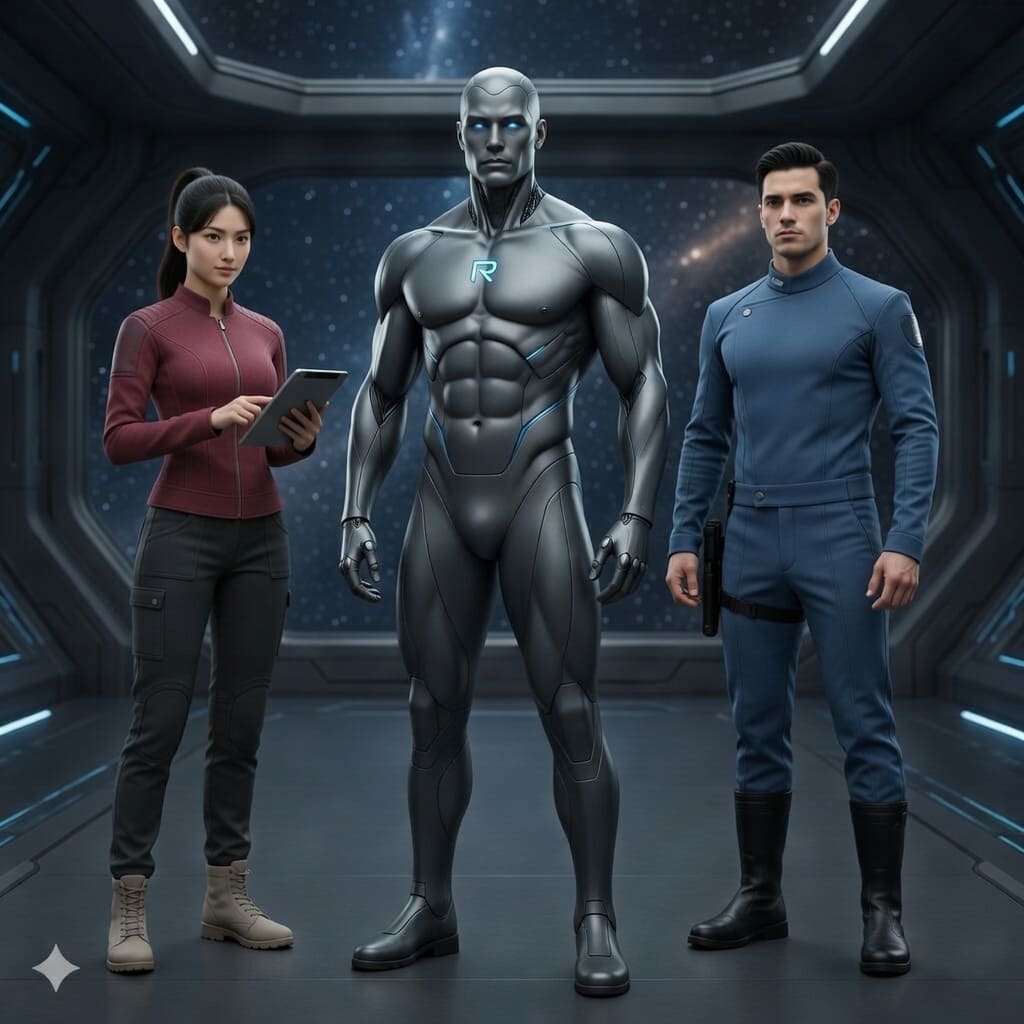
Ginnie, Robojit, and Victorson assemble in the first unified frame of the Robojit AI-generated cinematic universe.
The Robojit Pipeline: Rethinking Character Creation in the AI Era
Instead of spending millions to discover whether a character works, we can now test identity, chemistry, and tone early — and refine before scaling.
RMN Stars Robojit Desk
New Delhi | February 16, 2026
The entertainment industry is standing at a structural inflection point.
For decades, character development in film and animation has required large teams, long pre-production cycles, and high capital exposure before visual validation could even begin. Concept art, casting assumptions, test animations, lighting experiments — all of it traditionally happened behind closed doors.
The Robojit project is quietly testing a different model.
Instead of separating concept development, visual design, and motion prototyping into rigid production silos, we are building an AI-assisted pipeline that allows narrative, character, and cinematic proof-of-concept to evolve simultaneously.
This is not about replacing artists.
It is about compressing the feedback loop.
Phase 1: Canon Before Spectacle
We began by locking six core characters:
Robojit — the engineered synthetic axis
Victorson — institutional authority
Ginnie — agile intelligence
Donaldo — militarized domination
Goodhat — regal moral force
Zootaroo — conflicted warrior bound by obligation
Each character was developed using a structured “lock sheet” system:
- Defined psychological anchors
- Visual silhouette discipline
- Wardrobe architecture
- Lighting consistency
- Expression constraints
Rather than generating endless variations, we stabilized canonical versions. Each approved character was versioned and archived. This mimics traditional studio asset control — but achieved with AI-assisted tools.
The result: identity continuity before spectacle.
Phase 2: Multi-Character Composition
We then validated something critical:
Can AI maintain character identity across multi-figure compositions?
Using reference-conditioned generation, we successfully produced trio compositions that preserved:
- Facial geometry
- Body proportions
- Costume design
- Texture integrity
This is a non-trivial achievement. Most text-to-image systems drift heavily when combining multiple original characters.
Consistency is the foundation of cinematic universes.
Phase 3: Motion Prototype
The next leap was even more significant.
We generated short motion sequences featuring three canonical characters in synchronized dialogue and coordinated movement. Material textures remained intact. Posture and lighting remained coherent. Identity continuity survived temporal motion.
This moves the project from static concept art into pre-visualization territory.
The implication is clear:
Independent creative teams can now validate character chemistry and screen presence before traditional production investment.
Why This Matters to the Industry
Hollywood’s production pipeline evolved for a pre-AI era.
The Robojit experiment suggests a hybrid future:
- Smaller creative cores
- Faster visual validation
- Reduced early capital burn
- Iterative audience testing
- Scalable world-building
AI does not eliminate production value.
It shifts where value is created.
Instead of spending millions to discover whether a character works, we can now test identity, chemistry, and tone early — and refine before scaling.
This does not replace studios.
It modernizes pre-production.
A Signal, Not a Hype Cycle
Robojit is not positioned as “AI replacing film.”
It is positioned as a case study in:
AI-assisted universe building.
A repeatable pipeline.
A modular production methodology.
The early results — canonical stability, multi-character composition, and motion continuity — suggest something larger than a single graphic novel.
They suggest a new way to prototype entertainment properties.
And that is something the industry should be watching carefully.
About Robojit and the Sand Planet
Robojit and the Sand Planet is an original, creator-owned science-fiction franchise developed by mediapreneur Rakesh Raman. Conceived as a long-form narrative universe, the project explores themes of intelligence, power, restraint, and identity through the lens of human and synthetic coexistence.
The Robojit initiative is currently being developed through an AI-assisted production pipeline, combining human authorship with emerging generative tools for visual prototyping, storytelling experiments, and transmedia exploration. The pipeline is an ongoing exercise and continues to evolve with each stage of development.
Robojit Website | IMDb | FilmFreeway | ISA | YouTube | Twitter (X) | Facebook