
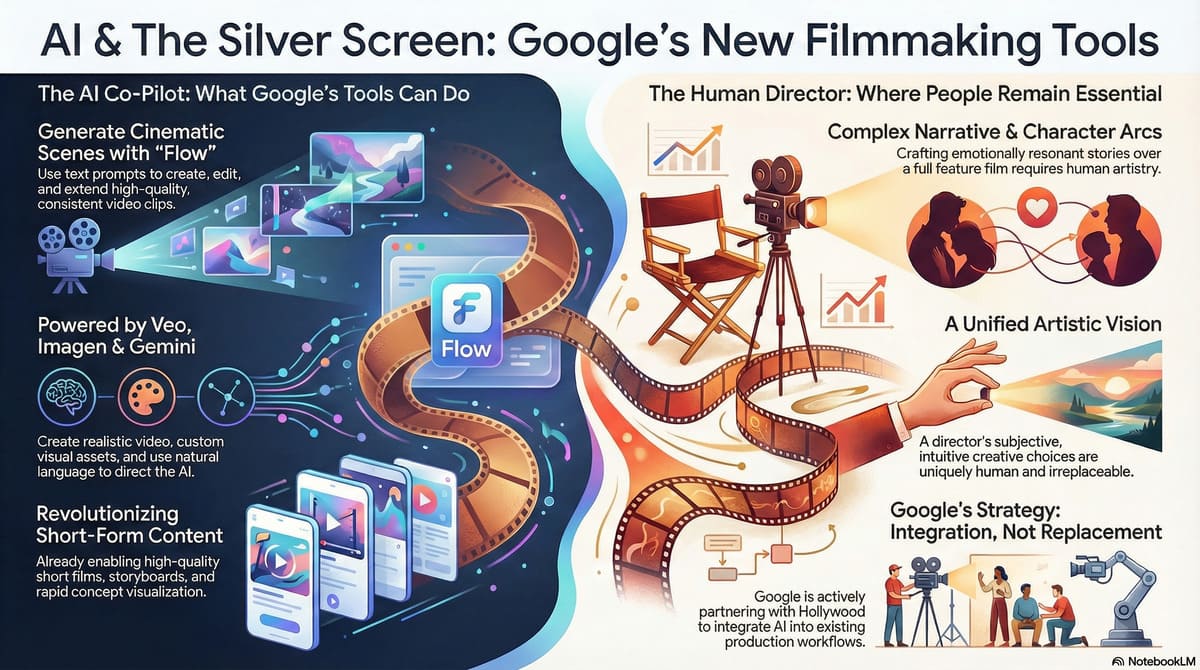
4 Surprising Truths About Google’s New AI Filmmaking Tools (It’s Not What You Think)
Google’s AI tools are not automating the director out of a job but are instead providing them with a dynamic new cinematic sandbox.
By Rakesh Raman
New Delhi | December 25, 2025
The headlines are filled with a dramatic narrative: AI is coming for Hollywood, ready to replace the director, the writer, and the entire creative crew. The idea of an AI-generated blockbuster taking over the big screen fuels both excitement and anxiety. But the reality of Google’s new AI filmmaking tools is far more nuanced, interesting, and collaborative than this simple myth suggests.
This post will cut through the noise to reveal four of the most surprising and impactful truths about how this technology is really changing filmmaking. It’s not about automating the director; it’s about augmenting their vision with a previously unimaginable digital toolkit.
1. It’s a Creative Co-Pilot, Not an Automated Director
While tools like Google’s Flow can generate impressively high-quality scenes and even complete short films—as seen in examples like “Kitsune,” “Electric Pink,” “Battalion,” and “NinjaPunk”—they are not capable of creating a full-length feature film from scratch. The dream of a completely automated movie remains a distant horizon for a reason.
A feature film’s power comes not from isolated shots, but from a unified artistic vision that guides everything from complex narrative arcs to the deep, subtle nuances of character—elements that AI can’t yet originate. Sustaining emotional resonance over 90+ minutes requires a human understanding of pacing and subtext, while the extensive post-production refinement needed for a polished, theatrical release still demands an artist’s touch.
Current AI serves to augment and accelerate this process, not take over the director’s chair. It empowers creators by handling time-consuming tasks and offering new avenues for visualization.
🔊 Google’s New AI Filmmaking Tools: Audio Analysis
Think of these innovations not as replacements for human creativity, but as powerful collaborators, amplifying your vision and streamlining your workflow.
2. It’s an Integrated Studio, Not Just a Single Tool
One of the biggest misconceptions is viewing Google’s offering as a simple text-to-video generator. The reality is that “Flow” is a comprehensive, integrated suite where specialized AI models work in concert. This combination is the secret sauce. Think of Gemini as the intuitive “director’s interface,” allowing you to use natural language to guide the process. Imagen acts as your “digital props and wardrobe department,” creating specific assets, while Veo serves as the “camera and physics engine,” rendering the final cinematic clips.
Within this digital studio, you don’t just get generic outputs; you get precise control. Instead of vague descriptions, you can direct Imagen with specific prompts like, “a weathered, ornate golden key with intricate carvings, resting on a velvet cushion” or “a sleek, chrome-plated hovercar, with glowing blue accents.” Gemini’s conversational nature enables a dynamic creative process. If you don’t quite like the first output, you can simply tell it, “Make the rain heavier and add more shadows,” and it will refine the scene accordingly.
A feature like “Scenebuilder” perfectly illustrates this power. By allowing a filmmaker to seamlessly extend shots or transition angles while maintaining perfect consistency, it solves a major historical problem for generative video, making it a viable tool for narrative continuity rather than just a novelty.
3. It Creates Immersive Sound, Not Just Silent Movies
A truly surprising leap forward is that these AI tools are no longer producing silent films. With the integration of Veo 3 in the Google AI Ultra plan, the system can now generate native audio to accompany its video clips, creating a much more complete experience right from the initial prompt.
For example, a filmmaker can prompt the system for a scene of “waves crashing on a rocky shore during a storm.” The AI will generate not only the powerful visuals but also the corresponding realistic sounds of crashing waves, howling wind, and distant thunder. This is a significant advance, adding a crucial layer of immersion to early drafts and storyboards while streamlining the workflow by reducing the immediate need for separate sound design.
4. It is Partnering with Hollywood, Not Trying to Replace It
Contrary to the common “tech disruption” narrative, Google is taking a strategic approach of active collaboration with the traditional film industry. This is not an invasion; it’s an integration designed to embed AI within established creative pipelines.
A key example is the “100 Zeros” initiative, a partnership with Range Media Partners. Through this project, Google is co-funding and co-producing projects that leverage their AI and spatial computing technologies. This strategy demonstrates a clear goal: to foster a symbiotic relationship where human creativity is amplified by technological advancement, proving that the goal is to enhance professional production workflows, not render them obsolete.
A New Cinematic Sandbox
Ultimately, Google’s AI tools are not automating the director out of a job but are instead providing them with a dynamic new cinematic sandbox. This technology is a powerful collaborator that reshapes the filmmaking process by accelerating visualization, streamlining asset creation, and opening up new creative possibilities. This frees the human director to focus entirely on the core of storytelling: emotional depth, narrative genius, and the singular artistic vision that unifies a film.
As these AI co-pilots become more powerful, what entirely new forms of storytelling will they unlock for human creators?
By Rakesh Raman, who is a national award-winning journalist and social activist. He is the founder of a humanitarian organization RMN Foundation which is working in diverse areas to help the disadvantaged and distressed people in the society.
As a technology and AI expert, his professional focus is on applying emerging AI and digital technologies to enhance decision-making, operational efficiency, transparency, and democratic participation in governance, media, and business systems. You can click here to view his full profile.