
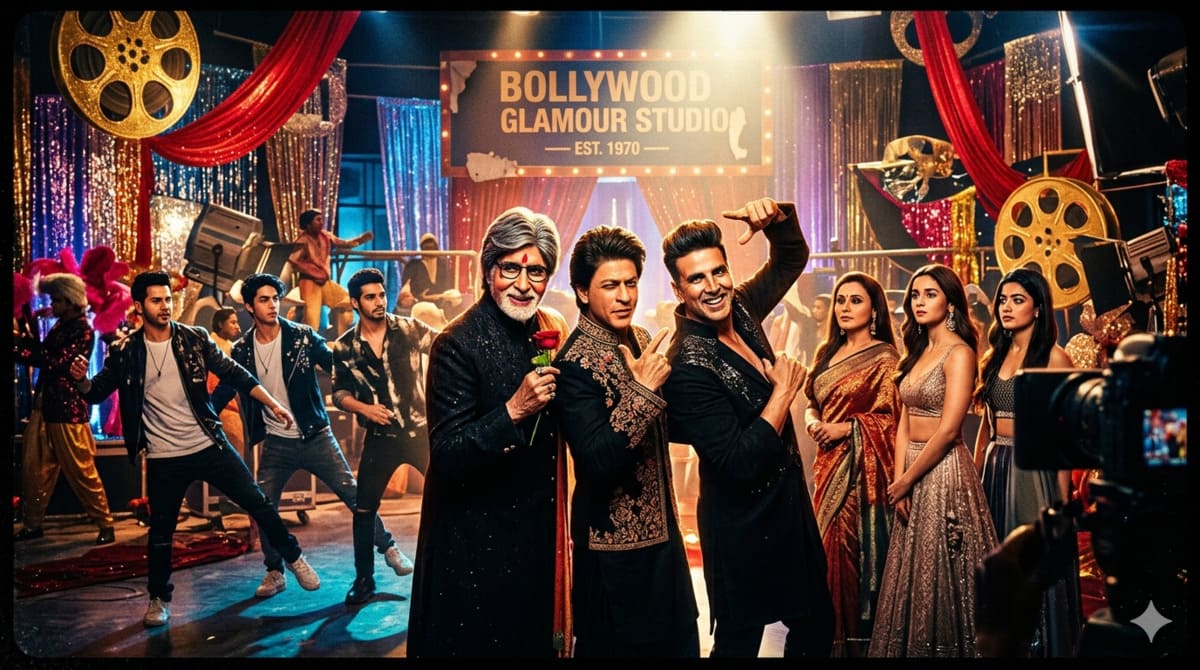
The Bollywood Illusion: An Investigative Report on Systemic Decay and Political Co-option in the Hindi Film Industry
RMN Stars Research Report Highlights:
- Linguistic Deception: Identifies how the term “Bollywood” serves as a deceptive linguistic lift from Hollywood to artificially inflate the stature of an industry capturing a negligible 1% of the global theatrical market.
- Dynastic Fiefdom: Analyzes the model where lineage consistently trumps talent, reducing high-budget cinema to an unprofessional “circus show” sustained by underpaid relatives to control minuscule budgets.
- Political Co-option: Examines the transformation of cinema into a “cultural soundtrack for political diversion,” utilizing hyper-nationalist propaganda to mask democratic backsliding and systemic domestic crises.
- Data Scams: Dissects the scandalous nexus between filmmakers and media outlets used to report inflated, “fudged” box office figures to bypass tax scrutiny and bamboozle a gullible public.
By Rakesh Raman
New Delhi | March 18, 2026
1. The Linguistic and Economic Mirage: Deconstructing the “Bollywood” Brand
The Mumbai-based Hindi film industry, colloquially known as “Bollywood,” is built upon a foundation of linguistic deceit. The name itself is a calculated lift from Hollywood, a desperate attempt to manufacture a veneer of global stature for an industry that fails to meet even the most basic international standards of professional excellence. This branding exercise creates an illusion of relevance that is flatly contradicted by the industry’s marginal economic reality and its creative bankruptcy.
Despite the self-aggrandizing rhetoric of its stars, the industry’s actual global footprint is negligible. While India produces approximately 2,500 films annually, the Hindi sector accounts for a mere 300. Its economic impact is equally underwhelming, as shown below:
| Metric | Bollywood (Hindi Industry) | Global Theatrical Market / Standards |
| Annual Film Volume | ~300 films | ~2,500 (Total India) |
| Global Market Share | ~1% | $70 Billion (Total Market) |
| Average Production Budget | ~$3 Million | Multi-billion dollar franchises (e.g., MCU, Avatar) |
| Creative Model | Archaic “Cookie-Cutter” Formula | Professional Script-Driven Pipelines |
To sustain its existence, the industry employs a “cookie-cutter recipe” designed to exploit the poorer, uneducated segments of society who lack alternative entertainment. This formula replaces narrative depth with meaningless songs and crude choreography.
🔊 बॉलीवुड का भ्रम और हिंदी फ़िल्म उद्योग का पतन: ऑडियो विश्लेषण
Furthermore, the industry’s treatment of women is symptomatic of its decay; actresses are reduced to mere “ornaments,” often included only to add a vulgar dimension or to artificially bolster the “romantic power” of aging male leads—some of whom are in their 60s or 70s—who spend their own money to maintain a fading spotlight. This creative vacuum has necessitated a reliance on family lineage over genuine merit.
2. The Dynastic Fiefdom: Meritocracy vs. Lineage
Bollywood has degenerated into an insular family fiefdom, an institutional capture where artistic innovation is suffocated by hereditary gatekeeping. This structural decay prevents independent artists from flourishing, as the industry prioritizes a “circus show” model sustained by the children and relatives of retired actors.
This “professional vacuum” is typified by the recent production Border 2, a definitive case study in dynastic dominance. The cast is a crowded assembly of industry descendants including Sunny Deol (son of Dharmendra), Varun Dhawan (son of David Dhawan), Ahan Shetty (son of Suniel Shetty), and Akshaye Khanna (son of Vinod Khanna).
This model is driven by a cynical economic logic: because these “nepo kids” would be jobless outside this ecosystem, they work for “peanuts.” This allows families to maintain absolute control over the industry’s meager $3 million average budgets while shutting out professional competition.
The lack of genuine professional demand leaves the fraternity in a state of idle stagnation, leading to “unprofessional side-gigs” intended to generate quick revenue:
- Performing at private marriage ceremonies for “trifling amounts.”
- Appearing at private birthday parties as hired entertainment.
- Inaugurating local neighborhood shops and markets.
Bereft of professional rigor, the fraternity has regressed into systemic irrationality. Incompetent actors frequently resort to “superstitious acts” to secure work, such as wearing specific “weird rings,” altering name spellings for luck, or insisting on specific house entrance orientations. This internal stagnation has left the industry uniquely vulnerable to external political co-option.
3. Cinematic Propaganda: The Strategic Pivot to Hyper-Nationalism
Having exhausted its creative reserves, the industry has transitioned into a tool for “narrative management,” providing a cinematic smokescreen for the ruling regime. Bollywood now serves as a cultural soundtrack for political diversion, masking democratic backsliding and institutional capture with manufactured valor.
A primary tactic is the “sanitization of national trauma.” The March 2026 title change of Battle of Galwan to Maatrubhumi: May War Rest in Peace was a calculated narrative pivot. By replacing a specific military failure with generalized patriotic sentiment, the filmmakers spread lies of “valour” to obscure the reality of soldier casualties. This cinematic heroism stands in stark contrast to real-world failures, such as the reality of the unapprehended Pahalgam attackers, which the industry conveniently ignores.
The “manufactured adversary” trope is further utilized in films like Lahore 1947 and Dhurandhar to satisfy a majoritarian base. These films employ “cinematic dog-whistling”—such as the line “It will enter your home and kill”—to:
- Reinforce aggressive rhetoric against Pakistan.
- Marginalize Indian Muslims as perpetual outsiders.
- Align with state-enforced propaganda, such as the January 2026 Ikkis incident where a hostile disclaimer regarding Pakistan’s “inhuman” conduct was coerced into the film.
These releases are strategically timed to distract from domestic crises, including the “Vote Chor Gaddi Chhod” (Vote Thief, Leave Office) campaigns and allegations of EVM manipulation. By focusing the public gaze on external enemies, the industry facilitates a decline in civic questioning.
4. Data Deceit and the “Paid News” Scandalous Nexus
To maintain the illusion of success amidst creative failure, the industry has embraced a culture of “data inflation.” A scandalous nexus has formed between production houses and struggling media companies to report “fudged” box office figures. This deception is driven by a specific fear of the Income Tax department; filmmakers cannot reveal true (or truly false) figures directly, so they use media outlets to claim revenues exceeding Rs. 100 crore (~$12 million) for mediocre films.
This culture of deceit extends to the social fabric of the industry. In a desperate bid to woo majority Hindu moviegoers, Muslim actors have begun “flaunting” visits to Hindu temples before film releases. Other fraudulent tactics include:
- The “House Full” Deception: Producers buy out entire theaters to hang “House Full” boards, creating a false sense of demand for films that are actually playing to empty seats before disappearing into streaming platforms.
- Staged Events: Launch parties are populated by hired audiences and individuals masquerading as journalists, paid to offer artificial praise and clap on cue.
- Shady Awards: Media organizations grant a surfeit of meaningless awards to keep the “dishonest money-making pursuit” intact and the public distracted by false glitz.
5. Global Backlash and the Technological Dead-End
The long-term strategic damage caused by Bollywood’s “punitive rhetorical style” has led to its rejection by the global community. The industry’s reliance on manufactured hatred and exclusionary nationalism has triggered an international backlash, resulting in bans of titles like Border 2 and Dhurandhar in major markets including Bahrain, Kuwait, Oman, Qatar, Saudi Arabia, and the UAE.
This global rejection highlights Bollywood’s inability to produce enduring franchises. While global cinema delivers multi-generational IPs like Zootopia 2 (approaching the $2 billion milestone) and Avatar: Fire and Ash (securing $1.5 billion in global cume), Bollywood remains tethered to “dummy directors” and “archaic formulas.”
Furthermore, dominated by a “naive and uneducated film fraternity,” the industry faces a technological dead-end, unable to effectively leverage Artificial Intelligence (AI) or lean production models.
Ultimately, the Hindi film industry has become a staged illusion designed to sustain the status quo. For the audience, the choice is clear: continue as passive spectators of this cinematic state or demand civic accountability and professional excellence over a carefully manufactured deception.
By Rakesh Raman, who is a national award-winning journalist and founder of the humanitarian organization RMN Foundation. As an emerging international screenwriter, his work is gaining visibility on leading entertainment industry platforms, including IMDb and the International Screenwriters’ Association (ISA).
He is building AI-assisted, manufacturing-style production pipelines for his global film and entertainment projects including the humanoid superhero transmedia IP ROBOJIT AND THE SAND PLANET and the research-based political thriller THE SMOKESCREEN which is envisioned as the first installment in a broader cinematic universe.