
Goodhat’s Greatest Wish Shapes Robojit Destiny
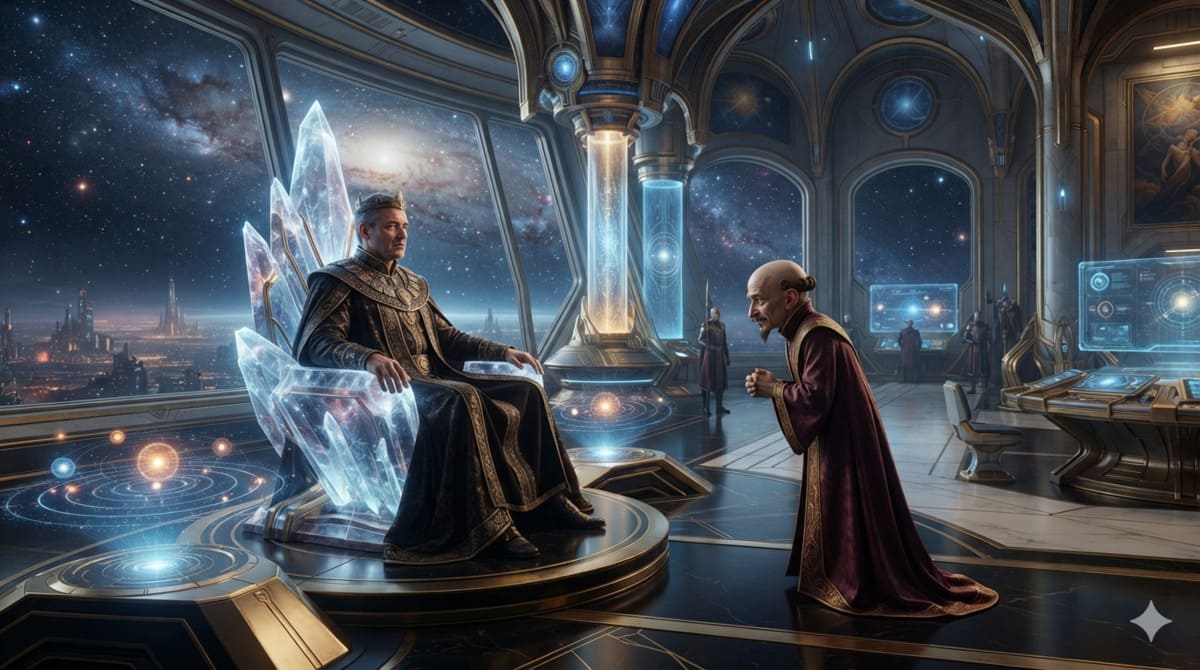
The emotional foundation of the Robojit Universe begins not with technology or war, but with a king’s longing for an heir. This AI-assisted visual adaptation of a pivotal scene from Robojit and the Sand Planet demonstrates how original human storytelling can be enhanced through modern AI-assisted filmmaking workflows while preserving the integrity of the source material.
RMN Stars Robojit Desk
New Delhi | August 21, 2026
Long before the emergence of Robojit, before extraordinary technologies reshaped civilizations across planets, the future of the Radon Empire rested upon a deeply personal struggle.
King Goodhat, the benevolent ruler of the vast Radon Empire, possessed wealth, scientific advancement, and the loyalty of countless civilizations spread across the known universe. His empire was so immense that even a supersonic spacecraft travelling continuously for one hundred days would fail to reach its outer boundary. Under his leadership, prosperity flourished and people from numerous planets lived together peacefully.
Yet behind this remarkable success lay an emptiness that no scientific achievement could overcome.
Despite advancing beyond fifty years of age, Goodhat and Queen Vilexi remained childless. The emperor’s greatest concern was not personal happiness alone, but the future of an empire whose stability depended upon wise leadership after his lifetime.
Seeking guidance, Goodhat summoned his trusted counsellor, Samwel, whose wisdom had served the empire faithfully for decades.
As the emperor revealed his despair, Samwel listened with compassion. Although their civilization had mastered extraordinary scientific achievements, even their technological capabilities appeared powerless before the mysteries of destiny.
Then Samwel recalled a legendary physician named Clarion, a medical genius living on the distant planet Nocter. Renowned for curing illnesses considered impossible elsewhere, Clarion represented a final hope for the emperor and queen.
Goodhat immediately agreed to undertake the journey.
Although this scene appears quiet compared with the large-scale adventures that later define the Robojit Universe, it establishes one of the most important emotional foundations of the entire saga. The fate of civilizations often begins with profoundly human hopes rather than spectacular battles.
This visual concept is part of the continuing development of ROBOJIT AND THE SAND PLANET, an original science-fiction universe created by Rakesh Raman.
The project also demonstrates the practical application of the AI-assisted, human-authored filmmaking workflow discussed in the RMN Stars research report, “Inevitability of Artificial Intelligence in Films — The Way Forward.” Artificial intelligence assists with visualization, cinematic concept exploration, production planning, and creative experimentation. However, the original story, screenplay concepts, world-building, editorial direction, and all major creative decisions remain authored and directed by Rakesh Raman, who wrote the original Robojit and the Sand Planet novel.
At a time when many industry observers have raised concerns about superhero fatigue caused by increasingly repetitive franchises and formula-driven sequels, original intellectual properties have become more valuable than ever. Fresh worlds, emotionally grounded storytelling, and distinctive characters may provide audiences with new cinematic experiences beyond established franchises.
RMN Stars welcomes discussions with major film studios, streaming platforms, animation companies, producers, publishers, and international production partners interested in exploring the adaptation of the Robojit Universe for films, premium streaming series, animation, graphic novels, interactive entertainment, and other emerging storytelling formats.
AI Production Note
This scene forms part of the AI-assisted, human-authored development workflow described in the RMN Stars research report Inevitability of Artificial Intelligence in Films — The Way Forward. AI is used to assist visualization, concept exploration, and production planning. The original story, characters, screenplay concepts, world-building, editorial direction, and creative decisions are authored and directed by Rakesh Raman.
About the Project
Robojit and the Sand Planet is an original, creator-owned science-fiction franchise developed by mediapreneur Rakesh Raman. Conceived as a long-form narrative universe, the project explores themes of intelligence, power, restraint, and identity through the lens of human and synthetic coexistence.
The Robojit initiative is currently being developed through an AI-assisted production pipeline, combining traditional storytelling methods with modern generative tools for visual prototyping, narrative experimentation, and transmedia expansion.
About the Author
Rakesh Raman is a national award-winning journalist, international screenwriter, and the founder of the humanitarian organization RMN Foundation. A former edit-page technology columnist for The Financial Express and digital media consultant for the United Nations (UNIDO), his work bridging media, technology, and creative writing is featured on leading entertainment industry platforms, including IMDb and the International Screenwriters’ Association (ISA).
As the creator of the proprietary RMN Stars Movie Anticipation Index (MAI), Rakesh specializes in evaluating the strategic and commercial potential of upcoming global cinematic releases. He currently leads entertainment market research initiatives, drives forensic investigations into cinema industry data laundering, and runs the “AI in Films: The Future of Enhanced Cinematic Technology“ information hub. He is also the author of the landmark research report, “Inevitability of Artificial Intelligence in Films: The Way Forward,” which is permanently archived in the global open-access scientific repository, Zenodo.
Robojit Website | IMDb | FilmFreeway | ISA | YouTube | Twitter (X) | Facebook