
THE SMOKESCREEN: Sloane Whitaker, Constitutional Council Judgments, and Sterling’s National Broadcast
While Sloane Whitaker examines a file containing strikingly identical Constitutional Council judgments on Digital Vote Units, Prime Minister Arthur Sterling publicly invokes those very rulings to defend the electoral system. Sequence 5 exposes the growing divide between private scrutiny and official certainty.
RMN Stars THE SMOKESCREEN Desk
New Delhi | November 6, 2026
The political crisis in the fictional Republic of Astraea takes a new turn in Sequence 5 of THE SMOKESCREEN. As investigative journalist Elias Thorne attempts to escape the network pursuing him, two events unfold in parallel: communications strategist Sloane Whitaker examines a sensitive government file, while Prime Minister Arthur Sterling appears on national television to defend the country’s Digital Vote Units (DVUs).
The sequence, titled “POWER SPEAKS,” shifts the focus from the immediate danger surrounding Elias to the institutions and public messaging at the center of the political controversy. It also raises a question that could become increasingly important: what happens when the language of official authority is accepted as a substitute for independent scrutiny?
Sloane Whitaker and the file that demands attention
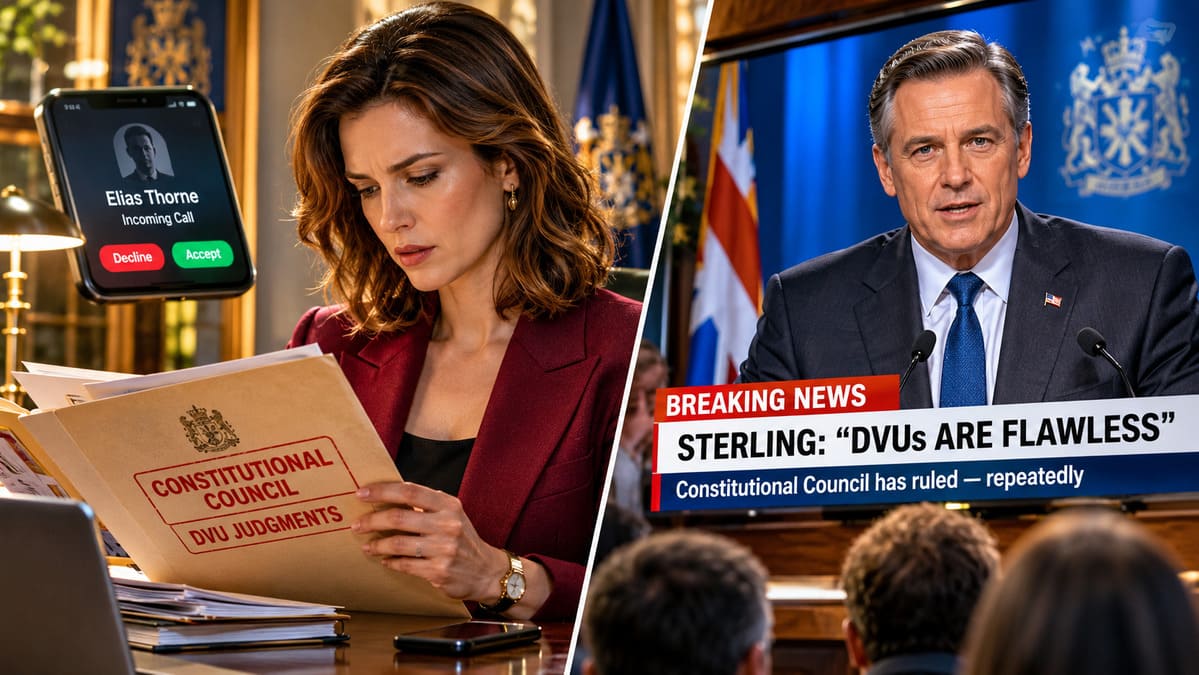
Inside a secure office at the Executive Secretariat, Sloane stands alone. On her desk is a file carrying a consequential title: “CONSTITUTIONAL COUNCIL — DVU JUDGMENTS.”
As she turns its pages, she encounters identical verdicts expressed in identical language. The screenplay does not yet establish why the judgments are worded this way or what conclusions should be drawn from their similarity. But the discovery is significant enough to place Sloane in a moment of private examination.
Her position makes the scene particularly revealing. Sloane is not an outside observer who has stumbled upon an obscure document. She operates within the political communications environment surrounding the government. The file therefore connects her professional world to the institutional framework being invoked publicly by the Prime Minister.
Her phone then buzzes. The caller is Elias Thorne.
Sloane hesitates before declining the call.
That brief action carries considerable dramatic weight. Elias is the journalist whose investigation has already attracted attention from unidentified pursuers. He has also received an encrypted message from Sloane aboard the train, informing him that Sterling will appear on national broadcast at 10 PM. Yet when Elias calls her, she chooses not to answer.
The screenplay leaves the reason unresolved. Is she protecting herself, avoiding a conversation that could compromise her position, or withholding information for a reason that will become clear later? The scene does not provide an answer. Its restraint makes the unanswered call more intriguing.
Sterling takes the argument to the nation
The setting then shifts to the national broadcast. Arthur Sterling appears on television, calm and smiling. His presentation contrasts with the uncertainty surrounding Elias and the private examination taking place inside the Executive Secretariat.
Sterling addresses the claims made by defeated political forces:
“Defeated forces claim machines chose me, not the people. The Constitutional Council has ruled — repeatedly — that Digital Vote Units are flawless.”
The statement is carefully constructed. It frames criticism of the electoral technology as an allegation by defeated opponents and presents the Constitutional Council’s rulings as the central answer to those allegations.
The Prime Minister is not merely defending a technical system. He is invoking institutional authority to reinforce the legitimacy of the election outcome. By connecting the DVUs to repeated judicial or constitutional determinations, his broadcast seeks to place the controversy within a framework of official certainty.
The accompanying images reinforce the presentation. Television anchors nod, while national flags appear behind Sterling. The broadcast becomes a carefully composed public spectacle in which political leadership, media presentation, and institutional legitimacy converge.
Two versions of the same political reality
The sequence’s strongest dramatic device is its contrast between the two locations.
In the Executive Secretariat, Sloane examines a file whose repeated language has caught her attention. On national television, Sterling confidently cites the Constitutional Council’s judgments as proof that the DVUs are flawless. The private scene introduces a question; the public scene delivers a definitive answer.
The screenplay does not establish that the judgments are invalid or that their identical wording proves misconduct. Instead, it places the two developments side by side and allows the audience to recognize the tension. That distinction is important to the credibility of the story. The investigation must establish what the documents mean rather than simply assume their significance.
Sloane’s unanswered phone call adds another layer. Her connection with Elias is now complicated by the institutional environment in which she works. She has information that may matter to the investigation, but the audience cannot yet determine how much she knows or what she intends to do with it.
The expanding conflict in THE SMOKESCREEN
Sequence 5 marks a shift in the scale of the conflict. The earlier sequences established the election-night shock, the publication of Elias’s investigation, the threat against him, and his escape from the safe house. The train sequence then introduced Sloane’s warning about Sterling’s scheduled broadcast.
Now the audience sees the other side of that development: the Prime Minister’s public response and the institutional claims supporting it.
The result is a political thriller in which the conflict is not limited to a journalist being pursued. It involves the relationship between government communications, constitutional authority, electoral technology, and the public’s understanding of political legitimacy.
The two-minute sequence also advances Sloane’s character without resolving her loyalties. Her access to the file, her hesitation over Elias’s call, and the timing of Sterling’s broadcast create a set of unanswered questions that can drive the next stage of the story.
THE SMOKESCREEN demonstrates a practical application of the AI-assisted, human-authored filmmaking workflow discussed in the research report Inevitability of Artificial Intelligence in Films — The Way Forward.
In “POWER SPEAKS,” the public message is confident, the private evidence is unsettling, and the relationship between the two remains unresolved. As Sterling speaks to the nation, the questions raised inside the Executive Secretariat remain unanswered.
To be continued…
Collaborations
Film studios, production companies, film producers, streaming companies, writers, visual artists, editors, cinematic designers, soundtrack composers, and other creative or industry collaborators interested in THE SMOKESCREEN are invited to connect with RMNStars for potential collaboration, film development, promotional campaigns, festival coverage, media partnerships, and related opportunities.
About the Author
About the Author: Rakesh Raman is a national award-winning journalist, independent publisher, and founder of the Raman Media Network (RMN), which operates multiple global news and entertainment platforms. As an emerging international screenwriter, his work is gaining visibility on leading entertainment industry platforms including IMDb and the International Screenwriters’ Association.
He has developed the proprietary RMN Stars Movie Anticipation Index, a specialized rating system designed to evaluate the strategic potential of upcoming cinematic releases. He has launched the “AI in Films” information hub on RMN Stars to analyze the transition of cinema into a medium defined by automated architectures and enhanced technology.
He is currently developing original global entertainment intellectual properties including THE SMOKESCREEN and ROBOJIT AND THE SAND PLANET, while also leading entertainment market research initiatives and investigative studies focused on cinema industry data integrity.
You can view his full profile at RMN News site.