The Constitutional Siege: CINTAA and FWICE Governance Meltdown
The Cine and TV Artistes’ Association and its parent body, the Federation of Western India Cine Employees, are currently locked in a bitter administrative civil war that has triggered a massive information vacuum for their members. This governance standoff, characterized by unverified election claims and conflicting leadership mandates, has left thousands of performing artistes in a state of total professional limbo.
By Rakesh Raman
New Delhi | September 10, 2026
1. The Administrative Standoff: A Union in Turmoil
The stability of a trade union is the essential bedrock that supports the collective bargaining power and professional security of performing artistes. When this foundation cracks, as seen in the escalating “civil war” between the Cine and TV Artistes’ Association (CINTAA) and its parent body, the Federation of Western India Cine Employees (FWICE), the entire social fabric of the industry is threatened. This is no mere internal disagreement; it is a fundamental breakdown of the hierarchy meant to protect labor interests, resulting in a dangerous fragmentation of authority that leaves workers vulnerable.
The current landscape is defined by a clash of contradictory directives that prioritize political posturing over member welfare. While the incumbent CINTAA leadership insists the organization remains fully operational, a disruptive narrative pushed by FWICE and its supporters suggests the current administration is illegitimate. This collapse of consensus between a subsidiary union and its parent federation has created a volatile atmosphere where the very legitimacy of the Executive Committee is the primary battlefield, leaving the rank and file without a trusted governing voice.
2. CINTAA’s Claim to Stability: The Constitutionality of Control
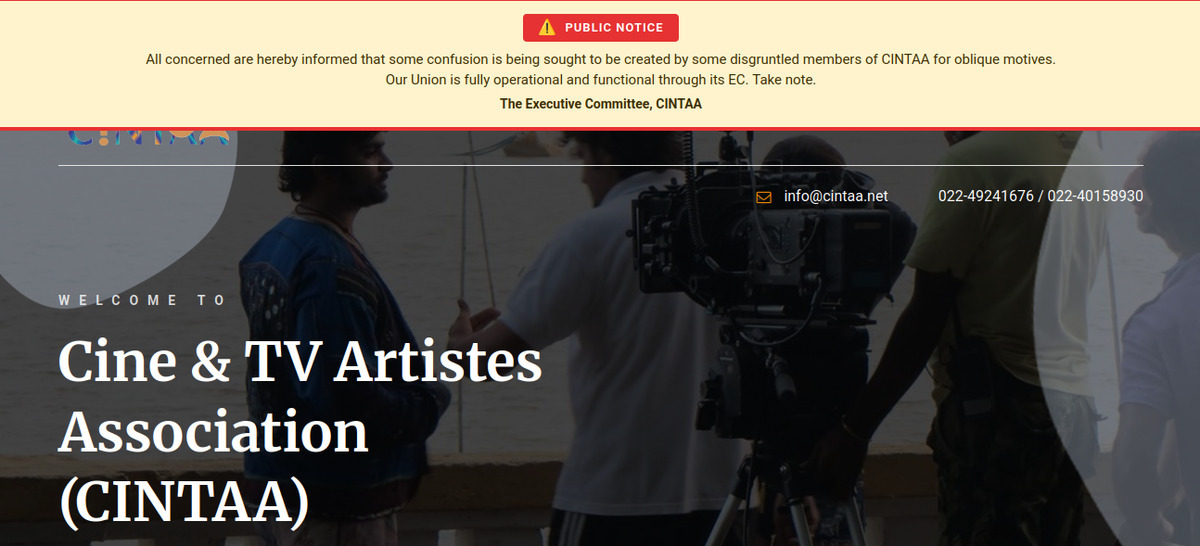
In a strategic effort to stem the tide of internal dissent, the CINTAA leadership continues to display a formal “Public Notice” seen on September 10, 2026 on the CINTAA website (pictured above). This move functions as a defensive maneuver, turning the union’s official portal into a digital fortress against external pressures. By publicly labeling opposition as the work of “disgruntled members with oblique motives,” the current board is attempting to consolidate power and neutralize the growing narrative of a leadership vacuum through a display of procedural defiance.
The legal strategy employed by President Poonam Dhillon’s faction rests entirely on a specific constitutional interpretation of the August mass exits. They argue that because only eight elected members resigned, the union did not reach the 50 percent constitutional threshold required for the automatic dissolution of the Executive Committee. Under this logic, the committee remains legally intact and functional, rendering any external attempt to mandate new elections an unlawful disruption of union sovereignty. While this legalistic shield provides a temporary defense, it does little to address the aggressive moves from external forces looking to force a change in the guard.
3. The FWICE Push: Shadow Elections and Legal Ambiguity
In the high-stakes environment of Mumbai’s entertainment industry, the circulation of unverified election rumors serves as a catalyst for strategic chaos. By bypassing official channels and leaking conflicting timelines, rival factions can effectively destabilize an incumbent administration. This creates a secondary, “shadow” authority that confuses the membership and forces a professional environment where loyalty is divided and legal obligations are obscured by hearsay.
Directly challenging CINTAA’s authority is a parallel narrative, backed by FWICE, which claims a mid-term election has been mandated for Saturday, September 12, 2026, at a school venue in Andheri West. Despite the reported involvement of 51 candidates, there is a total lack of official documentation to support these claims. While trade reports from September 9 suggest the Poonam Dhillon faction was denied an emergency stay by the Dindoshi Sessions Court, the “smoking gun” of this crisis is the complete absence of certified primary court orders or formal protocols. Without these documents, the legitimacy of the proposed Andheri West election remains entirely speculative.
4. The Transparency Deficit: Institutional Silence and Digital Failure
Effective trade body governance requires a high standard of transparent communication, particularly when the livelihoods of thousands of dues-paying members are at stake. When institutions go silent or fail to utilize their digital platforms during an administrative crisis, it represents a catastrophic failure of professional stewardship. Members do not pay union dues to be left in the dark; they pay for the clarity and protection that only a transparent administration can provide.
The digital conduct of both organizations represents an alarming display of institutional opacity. FWICE has enforced a total digital blackout, offering no official press packets or verified PDFs regarding the supposed election and its 51 candidates. Simultaneously, CINTAA has retreated into a social media vacuum, where its verified pages prioritize celebrity birthday wishes over addressing the systemic breakdown of its leadership. This failure has forced artistes to rely on private WhatsApp broadcasts and unverified trade leaks, a deeply unprofessional alternative that harms the individual workers who fund these bodies.
5. RMN Stars Conclusion: The Erosion of Artiste Trust
The ongoing confrontation between CINTAA and its parent body, FWICE, marks a significant erosion of trust in Bollywood’s most prominent talent unions. The shift from formal, transparent governance to a culture of closed-door meetings and shadow politics is a profound disservice to the artistes these organizations were built to serve. By allowing institutional infighting to supersede administrative duty, both bodies have abdicated their responsibility to provide stable leadership. Until certified, legally binding documents are produced to clarify the standing of the Executive Committee, the future of the union’s leadership remains completely up in the air.
About the Author
Rakesh Raman is a national award-winning journalist, international screenwriter, and the founder of the humanitarian organization RMN Foundation. A former edit-page technology columnist for The Financial Express and digital media consultant for the United Nations (UNIDO), his work bridging media, technology, and creative writing is featured on leading entertainment industry platforms, including IMDb and the International Screenwriters’ Association (ISA).
As the creator of the proprietary RMN Stars Movie Anticipation Index (MAI), Rakesh specializes in evaluating the strategic and commercial potential of upcoming global cinematic releases. He currently leads entertainment market research initiatives, drives forensic investigations into cinema industry data laundering, and runs the “AI in Films: The Future of Enhanced Cinematic Technology“ information hub. He is also the author of the landmark research report, “Inevitability of Artificial Intelligence in Films: The Way Forward,” which is permanently archived in the global open-access scientific repository, Zenodo.