The Udta Teer Propaganda Apparatus: How Bollywood Weaponizes India-Pakistan Animosity to Serve the Modi Regime
The upcoming Hindi spy-comedy Udta Teer serves as another explicit manifestation of Bollywood’s forced coordination (Gleichschaltung), weaponizing anti-Pakistan animosity to reinforce state-aligned political narratives. By forcing dynastic producers like Karan Johar into public displays of ideological submission, the Modi administration has converted mainstream entertainment into a state-managed PR apparatus. This structural capture uses high-budget cinematic spectacles to shield systemic governance failures and construct an artificial mandate of popular support.
Editor’s Note: This investigative report is integrated into our central data hub tracking institutional decay and administrative failures: Narendra Modi: Twelve Years of Misrule and the Illusion of Growth?
By Rakesh Raman
New Delhi | September 25, 2026
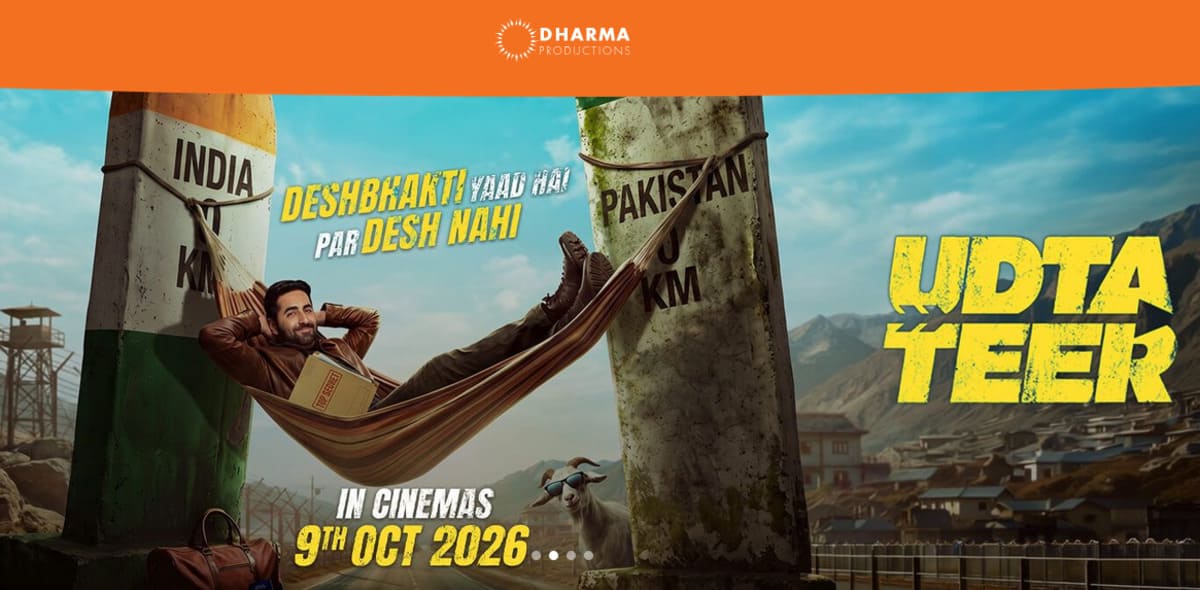
The upcoming Hindi spy-comedy film Udta Teer, scheduled for a nationwide theatrical release on October 9, 2026, serves as another clear example of modern Indian cinema weaponizing anti-Pakistan sentiment to echo the political priorities of Prime Minister Narendra Modi’s government. Directed by Aakash Kaushik and jointly produced by Dharma Productions and Sikhya Entertainment—under producers Karan Johar, Adar Poonawalla, Apoorva Mehta, Guneet Monga Kapoor, and Achin Jain—the film uses a comedic wrapper to deliver ideological messaging.
Cast, Crew, and Narrative Framework
- Lead Cast: Ayushmann Khurrana and Sara Ali Khan.
- Supporting Ensemble: Rahul Bose, Ram Kapoor, Gulshan Grover, Mukul Dev, Raghubir Yadav, and Brijendra Kala.
- Music: Composed by Sachin-Jigar.
- Core Plot Premise: Ayushmann Khurrana plays Bilal, a Pakistani intelligence operative who suffers severe amnesia following an unexpected explosion. Waking up without his memory, Bilal mistakenly comes to believe he is an ardent, hyper-patriotic officer serving in India’s Counter-Terrorism Squad (CTS). Sara Ali Khan portrays a fellow CTS officer navigating the situation while Bilal’s handlers across the border struggle to contain the fallout.
Excerpts from the Udta Teer trailer script make the film’s ideological intent explicit: dialogue lines explicitly evoke slogans like “Bharat Mata ki Jai”—a phrase central to the ruling BJP’s political rhetoric—alongside plot points highlighting that “Pakistani terrorists killed your parents” and that a “big attack is being planned against India.” The trailer builds its primary humor around the premise of a “Pakistani Jasoos Bana Hindustani Deshbhakt” (a Pakistani spy turned Indian patriot).
Dynastic Surrender and Ideological Compliance
The production background of Udta Teer highlights the wider structural submission of Bollywood’s traditional elites. In February 2026, producer Karan Johar made headlines by attending the Rashtriya Swayamsevak Sangh (RSS) Centenary celebrations, signaling that established dynastic film figures have accepted ideological alignment as a mandatory cost of doing business.
Also Read:
[ Modi Regime and Bollywood Forced Coordination ]
[ Modi and the Celebrity Propaganda Machine ]
Modern Indian cinema is undergoing a process of forced coordination that mirrors historical propaganda blueprints, converting commercial entertainment into a state-managed public relations mechanism. Major film figures perform mandatory displays of loyalty to mask systemic governance failures and social decline. This structural capture of Bollywood highlights the accelerating erosion of democratic norms and institutional independence across India.
Celebrity Devotion as State PR
In modern India, the line separating political authority from divine reverence has increasingly blurred. A prominent illustration of this personality cult occurred when retired Bollywood actor Suniel Shetty publicly shared that his 15-month-old granddaughter offers daily traditional sweets to a photograph of Prime Minister Narendra Modi placed directly alongside religious deities.
Such displays reflect an orchestrated effort by the Prime Minister’s Office to harvest both professional standing and personal devotion for political leverage. Shetty was subsequently named to an 18-member panel of the Central Board of Film Certification (CBFC), demonstrating how public expressions of allegiance are directly rewarded with state appointments and regulatory favor.
Despite a continuous stream of celebrity-driven narratives, a vast divide exists between state-sponsored stories and the everyday reality of 1.4 billion citizens. Expressions of personal devotion among film industry figures are not mere isolated incidents. Established actors and directors regularly execute public displays of submission to maintain commercial viability—industry leaders including Shah Rukh Khan, Salman Khan, Ajay Devgn, Akshay Kumar, Mohanlal, Kangana Ranaut, Jackie Shroff, and Shilpa Shetty routinely issue formal birthday tributes and public praises celebrating the Prime Minister.
The Historical Blueprint of Cultural Control
The structural alignment of Indian cinema reflects historical patterns of cultural control, specifically the process of Gleichschaltung—the forced coordination of independent social and cultural institutions under centralized control. During the 1940s in Germany, commercial cinema under Universum-Film Aktiengesellschaft (UFA) was systematically brought under government direction, culminating in the creation of the state-monopoly UFA-Film GmbH (Ufi).
That historical framework relied on three core objectives:
- Dehumanizing Targeted Communities: Utilizing popular entertainment to erode public empathy toward specific minority groups.
- Constructing Cults of Personality: Employing cinematic techniques and large-scale public spectacles to present political leadership as infallible.
- Obscuring Governance Failures: Distracting the public with high-budget escapist productions to conceal economic distress and civil rights abuses.
Modern Indian cinema increasingly echoes this operational model, using mass media as a public relations buffer to shield the state from critical scrutiny.
To see the official promotional video for this film, check out the Udta Teer Official Trailer. This trailer directly demonstrates how spy-comedy tropes and patriotic slogans are packaged to drive the film’s narrative.
About the Author
Rakesh Raman is a national award-winning journalist, international screenwriter, and the founder of the humanitarian organization RMN Foundation. A former edit-page technology columnist for The Financial Express and digital media consultant for the United Nations (UNIDO), his work bridging media, technology, and creative writing is featured on leading entertainment industry platforms, including IMDb and the International Screenwriters’ Association (ISA).
As the creator of the proprietary RMN Stars Movie Anticipation Index (MAI), Rakesh specializes in evaluating the strategic and commercial potential of upcoming global cinematic releases. He currently leads entertainment market research initiatives, drives forensic investigations into cinema industry data laundering, and runs the “AI in Films: The Future of Enhanced Cinematic Technology“ information hub. He is also the author of the landmark research report, “Inevitability of Artificial Intelligence in Films: The Way Forward,” which is permanently archived in the global open-access scientific repository, Zenodo.