
Beyond the Formula Trap: Why South Indian Cinema is Best Positioned to Forge India’s Global James Bond IP
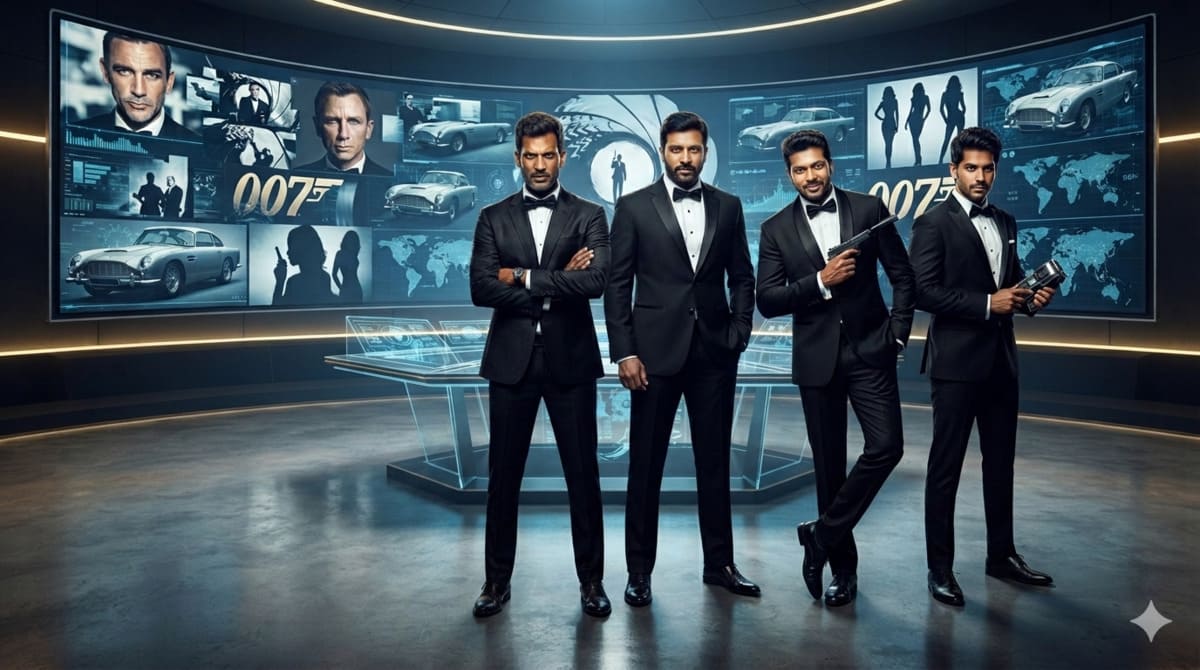
The Indian film industry suffers from a severe deficit of sustainable, globally recognizable intellectual property, relying instead on disposable, formulaic releases that lack narrative longevity. While official Hollywood parameters and casting rules strictly restrict the legendary James Bond franchise to British or Commonwealth actors, India has a golden opportunity to develop its own multilingual, high-value espionage IP. By moving past the creative inertia of Bollywood, filmmakers can leverage the raw talent of South Indian stars—specifically Vishal, Gopichand, Jayam Ravi, and Allari Naresh—to establish a sophisticated, cross-border spy universe tailored for international audiences.
By Rakesh Raman
New Delhi | July 15, 2026
The Global IP Crisis in Indian Cinema
For decades, Indian cinema has functioned primarily as a high-volume, low-durability content machine. Films are engineered for short-term theatrical runs, heavily reliant on manufactured box office hyperbole and derivative tropes. They appear with massive marketing noise and disappear from the global cultural consciousness just as quickly.
In a modern entertainment landscape increasingly dominated by enduring, transmedia global Intellectual Properties (IPs), the absence of a highly structured, sophisticated Indian espionage franchise is a glaring omission. The solution, however, does not lie in Bollywood.
In Bollywood, the spy genre has largely deteriorated into illogical, CGI-heavy spectacles that prioritize loud patriotism and gravity-defying action over complex character development, psychological tension, and narrative integrity. These films fail to resonate internationally because they lack the sophisticated, grounded, and cool intellectual core that makes franchises like James Bond globally immortal. To build an intellectual property capable of commanding high international distribution value, we must look beyond these run-of-the-mill formulas.
The Hollywood Reality: Decoding the Rules of Bond 26
To understand the architecture of a global spy franchise, we must first look at the official gold standard. Historically, the producers of the James Bond franchise at EON and Amazon MGM Studios have maintained a strict, non-negotiable casting rule: the actor portraying James Bond must be a British or Commonwealth citizen.
Furthermore, as the franchise gears up for Bond 26—with director Denis Villeneuve and casting director Nina Gold leading the search—the studio is actively targeting a “fresh face” in his late 20s or mid-30s. This long-term strategic commitment aims to secure an actor who can anchor the IP for the next decade. Consequently, leading Indian actors, who are mostly in their mid-to-late 40s and hold Indian citizenship, are structurally ruled out from the official Hollywood franchise.
Why South Indian Cinema Holds the Key to a Multilingual Spy IP
If an Indian studio is to build a legitimate, globally competitive spy IP, the project must be designed from the ground up to avoid the “Formula Trap”—a metric we regularly analyze at RMN Stars using our proprietary Movie Anticipation Index (MAI). To capture both local and international markets, this IP must be:
-
Multilingual by Design: Shot natively across key South Indian languages and Hindi, with high-quality English dubbing and localization to appeal to global streaming and theatrical markets.
-
Grounded in Archetypal Storytelling: Moving away from physics-defying action, the films must focus on distinct, highly specialized spy archetypes.
South Indian cinema, with its unmatched work ethic, technical precision, and gritty storytelling, offers the ideal talent pool to realize this vision. Here are four actors who perfectly match the essential archetypes of the modern secret agent:
1. Vishal: The “Daniel Craig” Archetype (Raw, Physical, & Relentless)
-
The Persona: The physically battered, emotionally guarded operative who relies on brute-force tactical combat, close-quarters street-fighting, and raw survival instincts.
-
The Strategic Case: Vishal possess the tall, rugged physique and intense screen gravity required for a gritty, modern spy. His work in Irumbu Thirai (2018) proved he can anchor high-stakes techno-thrillers, while Thupparivaalan (2017) highlighted his capacity to play an eccentric, physically aggressive investigator. He is the ultimate “demolition derby” agent who does his own grueling stunts.
2. Jayam Ravi: The “Pierce Brosnan” Archetype (Suave, Sophisticated, & Elite)
-
The Persona: The classic, immaculate gentleman spy. He is highly educated, visually stunning in a tailored tuxedo, effortless in high-society social engineering, yet ruthlessly lethal when the trigger must be pulled.
-
The Strategic Case: Jayam Ravi commands a highly sophisticated, calm, and elegant screen presence. His performance in the critically acclaimed psychological thriller Thani Oruvan (2015) is a masterclass in calculated, high-intellect cat-and-mouse games. Combined with the dark, gritty detective work of Iraivan (2023), Ravi is the ideal face for an elite, internationally positioned secret agent.
3. Gopichand: The “Tactical Commando” Archetype (The Heavy Military Operative)
-
The Persona: The seasoned field commander who thrives in active conflict zones. He represents the military intelligence side of espionage, dealing with tactical weaponry, cross-border counter-terrorism, and high-intensity extraction missions.
-
The Strategic Case: Gopichand’s towering stature, booming vocal delivery, and commanding physical presence make him a natural fit for heavy tactical operations. His role in Sahasam (2013)—a high-stakes treasure-hunt thriller set in hostile territory—and the relentless survival tension of Okkadunnadu (2007) prove he can carry large-scale military intelligence narratives with absolute conviction.
4. Allari Naresh: The “Deceptive Undercover Agent” Archetype (The Intellectual Mind Gamer)
-
The Persona: The low-profile, unassuming specialist. He does not look like an assassin, which is his greatest weapon. He wins through psychological warfare, masterclass acting, complex disguises, and cerebral manipulation.
-
The Strategic Case: Allari Naresh has an extraordinary dramatic range that allows him to pivot seamlessly from comedic deception to profound internal torment. His transition to dark, intense cinema in Ugram (2023) showed his ability to play a cold, relentless investigator. Coupled with the immense emotional grit of Naandhi (2021), Naresh represents the highly cerebral, undercover operative who outsmarts global syndicates with intellect rather than sheer muscle.
Evaluating the Strategic Potential: The RMN Stars Espionage Blueprint
A high-value espionage IP cannot rely on lazy storytelling. To achieve a strong rating on the RMN Stars Movie Anticipation Index (MAI), a project of this scale must prioritize narrative integrity, visual realism, and character-driven conflict.
| Potential Lead | Spy Archetype | Primary Narrative Strength | Crucial Precedent Films | Global IP Market Fit |
| Vishal | Daniel Craig | Brutal physical combat, techno-warfare, and high-intensity endurance. | Irumbu Thirai (2018), Thupparivaalan (2017) | Perfect for modern, gritty, realistic action franchises aimed at Western and East Asian markets. |
| Jayam Ravi | Pierce Brosnan | Suave elegance, high-society infiltration, and psychological chess. | Thani Oruvan (2015), Iraivan (2023) | Ideal for classic, high-budget, high-stylized global theatrical releases. |
| Gopichand | Tactical Commando | Macho screen authority, military weaponry, and heavy physical stunts. | Sahasam (2013), Okkadunnadu (2007) | Tailored for high-stakes, geopolitically driven military thrillers with broad global appeal. |
| Allari Naresh | Undercover Specialist | High adaptability, emotional range, and psychological manipulation. | Ugram (2023), Naandhi (2021) | Best fit for complex, character-driven independent spy thrillers and cerebral streaming series. |
Instead of waiting for Hollywood to widen its casting parameters, Indian production houses must recognize the structural shift in global entertainment. By utilizing the incredible, specialized acting talent of the South Indian film industry, writers and producers can craft a high-concept, multilingual espionage universe that respects the audience’s intelligence—creating a lasting, highly profitable global IP that stands the test of time.
About the Author
Rakesh Raman is a national award-winning journalist, international screenwriter, and the founder of the humanitarian organization RMN Foundation. A former edit-page technology columnist for The Financial Express and digital media consultant for the United Nations (UNIDO), his work bridging media, technology, and creative writing is featured on leading entertainment industry platforms, including IMDb and the International Screenwriters’ Association (ISA).
As the creator of the proprietary RMN Stars Movie Anticipation Index (MAI), Rakesh specializes in evaluating the strategic and commercial potential of upcoming global cinematic releases. He currently leads entertainment market research initiatives, drives forensic investigations into cinema industry data laundering, and runs the “AI in Films: The Future of Enhanced Cinematic Technology“ information hub. He is also the author of the landmark research report, “Inevitability of Artificial Intelligence in Films: The Way Forward,” which is permanently archived in the global open-access scientific repository, Zenodo.