The Bollywood Ufi Blueprint: How Mandatory Loyalty and Manufactured Milestones Mask Institutional Collapse
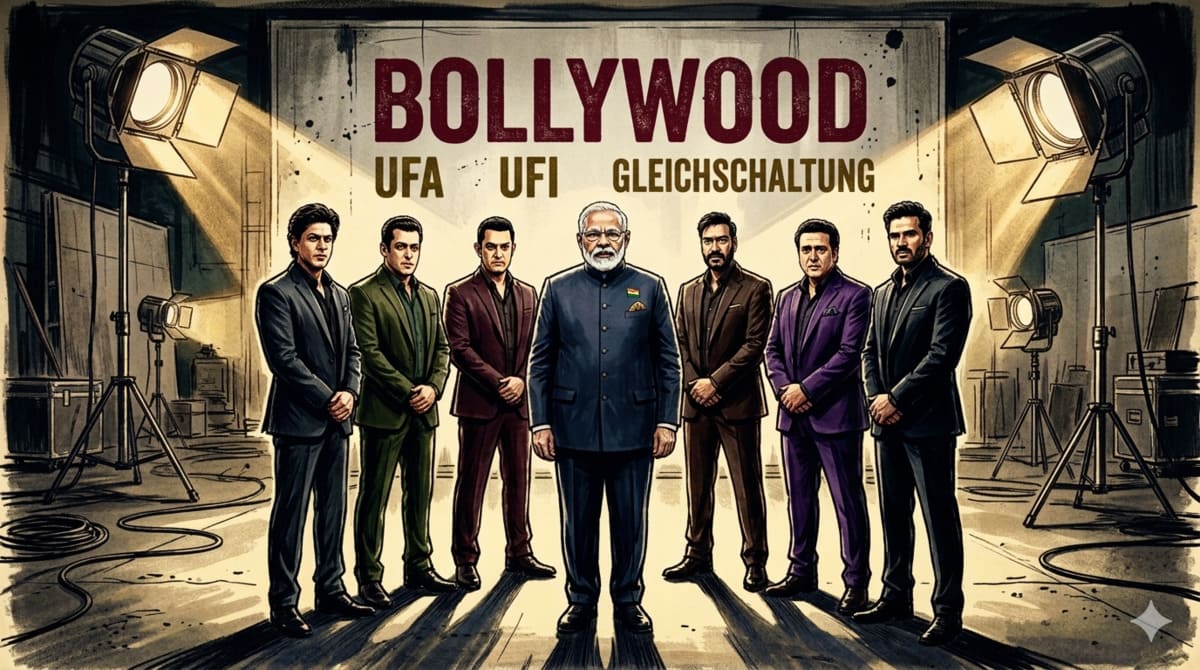
Modern Indian cinema has entered a phase of total state-managed coordination—mirroring the 1940s German UFA/Ufi blueprint—where commercial entertainment is systematically weaponized to distract from structural national damage.
By Rakesh Raman
New Delhi | June 27, 2026
In June 2026, as Prime Minister Narendra Modi crossed a historic 4,399 consecutive days in office to become India’s longest continuously serving elected leader, a massive influx of high-profile Bollywood sycophancy from figures like Ajay Devgn, Kangana Ranaut, and Govinda flooded the public square. This calculated display of mandatory loyalty, alongside the multi-crore data-laundering rackets fueling films like Peddi and Dhurandhar, functions as an engineered cultural smokescreen designed to hide severe economic crises, foreign capital flight, and systemic institutional capture.
The Flattery Wall: Milestone Sycophancy as a Political Shield
The celebration marking Narendra Modi’s 12-year continuous tenure as an elected leader has exposed the absolute surrender of India’s entertainment elite to a centralized regime. A heavily managed public relations apparatus has transformed what is editorially analyzed as a period of systemic misrule into an uncritical celebration of absolute authority.
A cross-section of industry veterans led the public adulation:
-
Govinda hailed the 4,399-day milestone as a matter of “India’s self-respect,” explicitly praising the Prime Minister’s discipline and controversy-free public service.
-
Ajay Devgn congratulated the leader on a “historic democratic feat,” validating a long-standing tenure that critics argue has systematically eroded democratic guardrails.
-
Kangana Ranaut aggressively pushed the narrative forward, stating that this 12-year tenure was “just the beginning” of a proud, nationalist era for the nation.
-
Anupam Kher, Subhash Ghai, and Madhur Bhandarkar uniformally lauded the government’s focus on national culture and an elevated global presence, acting as a direct public relations buffer against reality.
Even figures like Suniel Shetty have pivoted toward deeply personalized adoration, publicly sharing anecdotes of his 15-month-old granddaughter offering daily traditional sweets to a photograph of the Prime Minister placed alongside religious deities.
Also Read:
[ Bollywood’s Surrender: Cinema as State Propaganda ]
[ Bollywood: The Global Gold Standard for Logic-Free Cinema ]
This display of worshipful adulation is not accidental; it is a survival mechanism. Actors like Shah Rukh Khan, Salman Khan, and Aamir Khan continuously perform “mandatory loyalty” through highly visible, submissive birthday pledges and public bows to organizations like the Rashtriya Swayamsevak Sangh (RSS)—an outfit facing intensifying scrutiny from the international community.
The UFA / Ufi Blueprint: A Historical Warning
To understand the structural capture of Bollywood in 2026, one must analyze Germany in 1942. The trajectory of modern Indian cinema directly mirrors the historical blueprint of Gleichschaltung—the forced coordination of all independent social and cultural institutions under totalitarian control.
🔊 बॉलीवुड का यूफी ब्लूप्रिंट और प्रचार तंत्र: ऑडियो विश्लेषण
Originally, UFA (Universum-Film Aktiengesellschaft) operated as Germany’s premier commercial film enterprise. However, through strategic acquisitions by right-wing media moguls inside Hitler’s cabinet and covert state stock-buying, the Nazi regime systematically choked out creative independence. By 1942, Propaganda Minister Joseph Goebbels consolidated all competing entities into a singular, state-owned super-monopoly: UFA-Film GmbH (Ufi).
The Ufi blueprint executed three distinct, unyielding strategic objectives:
-
Dehumanizing Minorities: Transforming scripted theatrical fiction into a weapon to systematically strip targeted communities of empathy.
-
Manufacturing Cults of Personality: Employing sweeping cinematic spectacle, grand camera angles, and manufactured crowds to portray the leader as an infallible, messianic savior.
-
Hiding Criminality Behind Spectacle: Flooding the market with high-budget, lavish escapist entertainment to keep audience ratings perfect, successfully masking domestic economic despair and state atrocities.
Modern Bollywood has become the digital-age execution of this exact Ufi blueprint. By forcing established dynastic powers—including industry gatekeepers like Karan Johar and Ranbir Kapoor—to attend events like the RSS Centenary, the state has mandated that ideological certification is a prerequisite for corporate survival.
The Tactical Retconning of the Release Slate
Modern Indian cinema is no longer characterized by artistic expression; it is defined by retconning—the deliberate retrofitting of historical narratives to serve contemporary political objectives. The current theatrical release slate speaks directly in the ideological vocabulary of the ruling regime:
-
Peddi: Lead actor Ram Charan explicitly admitted to anchoring the commercial sports drama around the central government’s “Viksit Bharat” propaganda slogan, successfully expanding state narrative control from Bollywood deep into regional South Indian cinema.
-
Dhurandhar & Dhurandhar 2: Function as massive financial illusions. In April 2026, actor Ranveer Singh executed a forensic defensive maneuver by visiting the memorial of RSS founder Keshav Baliram Hedgewar. By securing an explicit audience with RSS chief Mohan Bhagwat, Singh successfully manufactured a political “shield” to protect his film from critical audits regarding unverified global box office tracking data.
-
Batwara 1947, Aakhri Sawal, Battle of Galwan, Ikkis, and Border 2: A coordinated wave of militaristic and hyper-nationalist features designed to keep the domestic electorate in a state of perpetual external anxiety, directly serving the regime’s domestic security narrative.
The Smokescreen: Decorative Rackets vs. Structural Fractures
The manufactured euphoria generated by these films and celebrity pledges exists to mask a grim institutional landscape. This cinematic alignment serves as the decorative outer layer of a profound domestic crisis.
As documented in the comprehensive, ongoing investigative research project, Narendra Modi: Twelve Years of Misrule and the Illusion of Growth, the reality hidden behind the Ufi-style spectacle includes:
-
The Fiscal Crisis: A ballooning national debt and an unprecedented collapse in net Foreign Direct Investment (FDI), signaling massive international capital flight.
-
Institutional Capture: The systematic transformation of independent tracking metrics and judicial frameworks into automated mechanisms of electoral autocracy and high-level graft immunity.
-
Layman Despair: Exploding systemic joblessness and an uninvestigated culture of impunity that leaves the domestic populace stranded behind a 50-year recovery horizon.
Against this total simulation of national success, the inflated box office receipts pushed by shady tracker sites and printed by compliant media cartels are exposed as a coordinated data-laundering mechanism. By stripping away independent data tracking parameters—such as those highlighted by global ledgers like Comscore—the domestic entertainment machinery acts as an economic mirage. When film dynasties completely surrender to ideological coordination, numerical truth is obliterated, leaving independent reporting as the sole filter capable of unmasking the facade.
Archived Report | RMN News Service & RMN Stars Investigative Division
This report is part of the ongoing research: “Narendra Modi: Twelve Years of Misrule and the Illusion of Growth?”
By Rakesh Raman, who is a national award-winning journalist and social activist. He is the founder of the humanitarian organization RMN Foundation which is working in diverse areas to help the disadvantaged and distressed people in the society.