

THE SMOKESCREEN: Inside a System Where Power Shapes Truth
The Smokescreen is an AI-assisted, human-authored political thriller feature film project.
RMN Stars THE SMOKESCREEN Desk
New Delhi | May 6, 2026
In the Republic of Astraea, democracy appears to function with reassuring familiarity. Elections are conducted with ritual precision, leaders emerge through what seems to be public mandate, and opposition voices rise at expected intervals to challenge authority. News cycles move with urgency, debates unfold across platforms, and the machinery of governance projects an image of balance and accountability. To an ordinary observer, nothing seems fundamentally broken.
Yet, beneath this surface, patterns begin to form—subtle at first, almost indistinguishable from coincidence. Electoral outcomes follow a rhythm that feels too consistent. Political messaging, even when delivered by opposing sides, carries a strange coherence. Moments of crisis rise and dissipate with timing that appears managed rather than organic. These are not anomalies that announce themselves loudly. They exist in the margins, detectable only to those willing to look beyond the immediate spectacle.
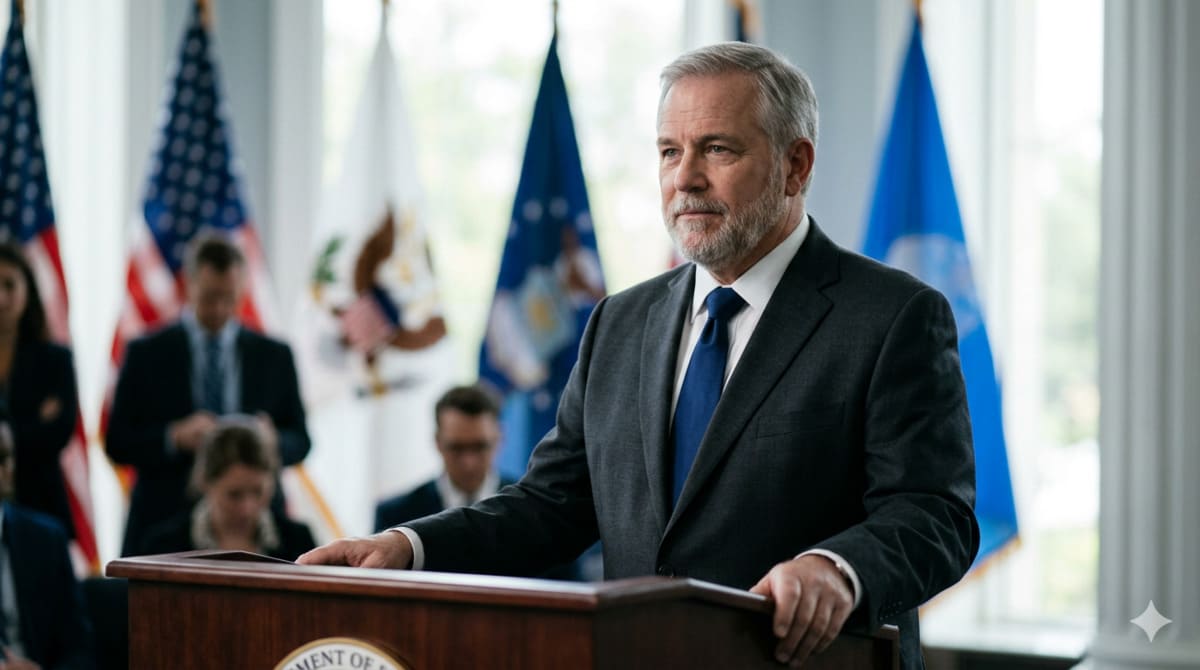
At the center of Astraea’s political landscape stands Prime Minister Arthur Sterling, a figure who embodies stability and control. His public persona is carefully calibrated—measured, authoritative, and rarely reactive. Sterling does not govern through visible force or overt suppression. Instead, he operates with an understanding that in modern systems, power is most effective when it does not appear coercive. His influence is not defined by what he restricts, but by what he allows to be seen. In this sense, Sterling’s authority extends beyond governance into the domain of perception itself.
Working behind this visible structure is Sloane Whitaker, a strategist whose presence is rarely acknowledged but whose influence is pervasive. Whitaker does not engage in public discourse, nor does she seek recognition. Her domain is quieter and more consequential—the construction of narrative. In a system saturated with information, she understands that control does not require censorship. It requires selection, emphasis, and timing.
Facts are not eliminated; they are repositioned. Stories are not fabricated wholesale; they are guided, shaped, and embedded within a broader framework that determines how they will be interpreted. Under her direction, the flow of information becomes a tool, capable of diluting inconvenient truths without ever needing to deny them outright.
Opposing Sterling in the public arena is Alistair Finch, a figure widely regarded as the voice of resistance. Finch’s speeches carry conviction, his criticisms resonate with segments of the population, and his presence reinforces the perception that power in Astraea is actively contested. He is articulate, strategic, and acutely aware of the political environment in which he operates. Yet, his challenges, while forceful in tone, rarely translate into disruption at a structural level. The system absorbs his dissent without visible strain. His role, whether by design or circumstance, exists within boundaries that are never formally declared but consistently observed.
This dynamic introduces a more complex interpretation of opposition itself. In Astraea, resistance does not necessarily destabilize power. It can, in fact, reinforce it. By providing the appearance of choice and contestation, figures like Finch contribute to the legitimacy of the system. The public sees debate, disagreement, and the promise of change, and in doing so, is reassured that the democratic process remains intact. The possibility that opposition might be integrated into the system it appears to challenge is not easily confronted, yet it lingers as a persistent undercurrent.
Amid this interplay of authority, narrative, and dissent, a different perspective begins to take shape through Elias Thorne, a journalist whose approach is grounded not in ideology but in observation. Thorne’s work does not begin with assumptions of wrongdoing. It begins with data, patterns, and the quiet accumulation of inconsistencies that resist easy explanation. As he traces these threads, what emerges is not a single point of failure or a discrete act of manipulation, but a structure—layered, adaptive, and remarkably coherent.
Thorne’s investigation leads him to a disquieting realization: the system does not depend on secrecy in the conventional sense. Information is available, events are reported, and institutions continue to operate. What is absent is not truth itself, but clarity. Facts exist, but they are dispersed, contextualized, and often overshadowed by competing narratives that dilute their significance. The result is a landscape where truth is not hidden in darkness but submerged beneath an excess of visibility.
What distinguishes the system in Astraea is its resilience. It does not rely on rigid control mechanisms that can be easily identified and challenged. Instead, it functions through alignment. Power, narrative, and opposition operate in a manner that maintains equilibrium. Pressure is absorbed, criticism is contained, and disruption is minimized without the need for overt intervention. It is a model that does not break under scrutiny because it is designed to accommodate it.
As Thorne moves closer to articulating this structure, the nature of his challenge becomes increasingly clear. He is not confronting a single authority or exposing a singular truth. He is attempting to reveal a system that defines how truth itself is perceived. In doing so, he faces not only institutional resistance but also the inertia of public belief. A narrative, once established and internalized, does not yield easily to contradiction.
The phrase that echoes through this unfolding reality—“the truth is buried beneath power”—captures more than a thematic idea. It describes a method. Truth in Astraea is not eradicated; it is layered over, reframed, and positioned in ways that prevent it from disrupting the larger structure. It remains present, but inaccessible in any form that could challenge the system effectively.
THE SMOKESCREEN presents this world not as a distant abstraction but as a constructed reality that feels plausible in its mechanics and implications. It is a story where individuals matter, but systems matter more. Where power is exercised quietly, narratives are engineered with precision, and opposition exists in forms that may both challenge and sustain the status quo.
In Astraea, the question is not whether truth exists. It is whether it can ever emerge intact in a system designed to keep it buried.
Logline
After discovering evidence of systemic election manipulation in the Republic of Astraea, journalist Elias Thorne confronts a regime that hides behind patriotism, crisis, and calculated distractions. As domestic institutions fail him, he prepares to escalate the battle beyond national borders — risking exile, reputation, and his life.
THE SMOKESCREEN
The Smokescreen is an AI-assisted, human-authored political thriller feature film project created by Rakesh Raman. Set in a fictional republic, the story follows an investigative journalist who uncovers systemic electoral manipulation and institutional corruption within a powerful regime. Blending investigative realism with geopolitical suspense, The Smokescreen explores themes of truth, power, information warfare, and the fragility of democratic systems.
The project is currently in advanced story development and is designed with international appeal and franchise scalability in mind.
About Rakesh Raman
Rakesh Raman is a national award-winning journalist and editor of the RMN news network. Alongside The Smokescreen film project, he is also developing Robojit and the Sand Planet, an original sci-fi superhero adventure set on a mystic world where young inventors and a heroic humanoid warrior named Robojit battle a tyrant to restore galactic peace.
As an emerging international screenwriter and transmedia creator, Raman’s projects are gaining visibility on leading entertainment industry platforms, including IMDb and the International Screenwriters’ Association (ISA). His work bridges investigative journalism, cinematic storytelling, and technology-enabled creative development.