
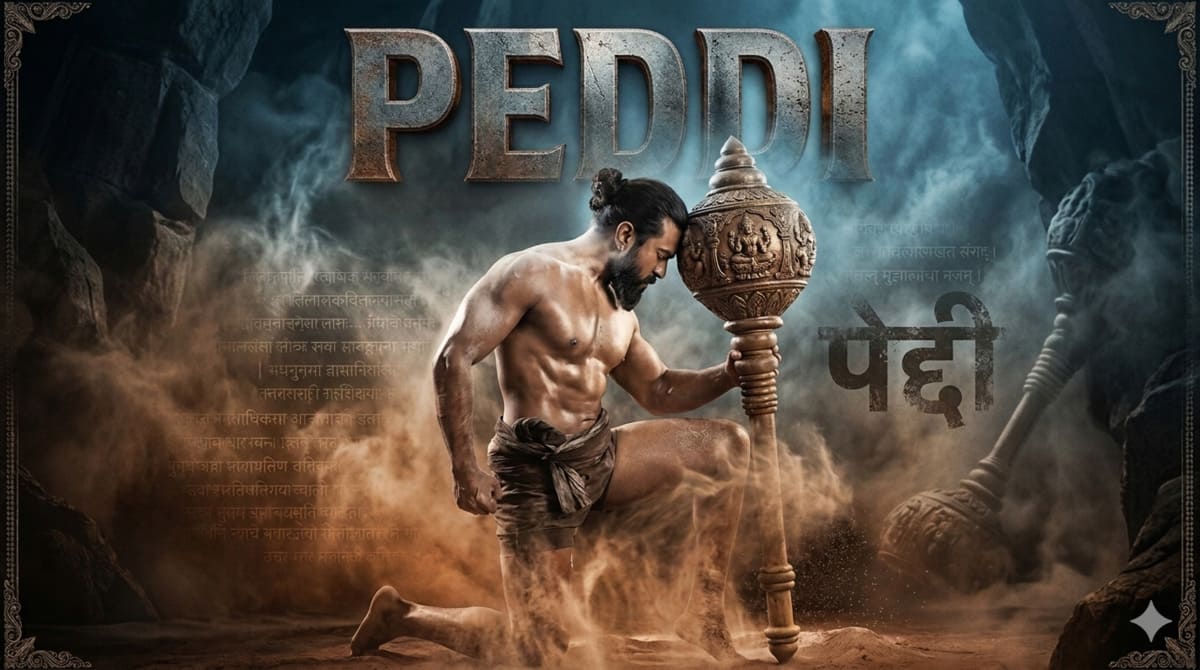
Nepo Kid Ram Charan to Promote Modi’s Viksit Bharat with Telugu Film Peddi as Bollywood’s Gleichschaltung Virus Infects South Indian Cinema
The highly anticipated Telugu sports drama Peddi has been exposed as a vehicle for state-aligned political propaganda ahead of its June 4, 2026 release. Lead actor and industry “nepo kid” Ram Charan explicitly admitted to anchoring the film around Prime Minister Narendra Modi’s “Viksit Bharat” slogan, signaling a dangerous expansion of state-managed narrative control from Bollywood into regional South Indian cinema. This systemic surrender by high-profile filmmakers highlights a growing crisis of creative independence across India’s entertainment landscape.
By Rakesh Raman
New Delhi | May 30, 2026
The Southward Spread of the Gleichschaltung Virus
For years, the Indian entertainment landscape has witnessed a systematic alignment between corporate filmmaking and state-directed narratives. This phenomenon is known as Gleichschaltung—a term originating from historical totalitarian regimes that describes the forced coordination of all aspects of society, including culture, media, and cinema, to serve a single ruling political power. While Bollywood has long succumbed to this virus through state-sycophantic features, the upcoming release of director Buchi Babu Sana’s Peddi proves that the contagion has fully breached regional borders into South Indian cinema.
In an explicit demonstration of this structural alignment, lead actor Ram Charan publicly leveraged a promotional interview to recount a recent personal discussion with PM Narendra Modi in New Delhi. Charan admitted he directly informed the Prime Minister that the core concept of Peddi directly mirrors the state’s signature political campaign: “Sir, it is about how Viksit Bharat is about empowering of our villages. Waisa hi concept hai Sir.”
By actively injecting “Viksit Bharat” (Developed India)—the ruling regime’s central electoral branding slogan—into the film’s pre-release marketing, the creators of Peddi have traded artistic integrity for political patronage.
The Dynastic Alliance: Nepotism and State Protection
The orchestration behind Peddi highlights a transactional alliance between dynastic film families and the political establishment. Ram Charan, widely recognized as a product of deep-seated industry nepotism as the son of megastar Chiranjeevi, belongs to an elite bloodline network that increasingly relies on political compliance to protect its commercial supremacy.
This symbiotic relationship extends deeply into regional politics. Charan’s uncle, Pawan Kalyan, the leader of the Jana Sena Party, recently ascended to the position of Deputy Chief Minister of Andhra Pradesh within a political landscape heavily shaped by central regime dynamics and strategic alliances. To secure nationwide administrative immunity, tax concessions, and state-backed distribution support, these dynastic “nepo kids” use their massive cinematic platforms to validate the ruling party’s policy rhetoric.
Institutional Compliance and Media Laundering
While the ideological surrender of the filmmakers ensures local state protection, institutional tracking networks are simultaneously utilized to project an illusion of organic commercial success. Instead of relying on transparent, verified data, global box office tracking frameworks are routinely manipulated. Data is often aggregated under ambiguous tracking tags to mask actual theater occupancies and missing audit trails.
Mainstream Indian media outlets then latch onto these unverified corporate metrics, generating live-commentary feeds that inflate a film’s cultural importance while burying critical reception beneath a wall of state-sanctioned enthusiasm. This creates an echo chamber where unverified “estimates” are laundered into the public record as objective financial news, insulating politically compliant filmmakers from the consequences of artistic failure.
A Multi-Pronged Propaganda Grid
The co-opting of Peddi is not an isolated incident but rather part of a broader, multi-regional cinematic grid designed to support state narratives. Across the industry, dynastic actors who would face diminishing relevance in a strictly merit-based marketplace are being propped up as the face of regime-friendly content:
-
Religious Demagoguery: Upcoming major projects like Ramayana, starring Ranbir Kapoor and Sunny Deol, are engineered to align with the state’s heavy reliance on cultural and religious mobilization.
-
Border Narrative Revisions: Salman Khan’s Battle of Galwan (also known as Maatrubhumi) attempts to depict a heavily sanitized version of military engagements with foreign counterparts, projecting a state-approved narrative of undisputed triumph.
-
Electoral Conflict Rhetoric: Aamir Khan and Sunny Deol’s Lahore 1947 directly feeds into the cross-border hostility that regularly serves as the political establishment’s primary electoral fuel.
Ultimately, Peddi represents a critical flashpoint where creative expression is entirely subverted to legitimize political slogans. As South Indian cinema increasingly adopts Bollywood’s compliant playbook, independent artistry is systematically erased, turning the theater screen into a mere extension of the state’s PR machinery.
By Rakesh Raman, who is a national award-winning journalist and social activist. He is the founder of the humanitarian organization RMN Foundation which is working in diverse areas to help the disadvantaged and distressed people in the society.